Using AI to predict student success in NEET and JEE: what actually works in 2026
Blog
Leave your details and our counselors will reach out to you shortly.
🎧 Listen to this article
Using AI to predict student success in NEET and JEE: what actually works in 2026
Quick summary
- AI tools can now flag weak chapters, predict score ranges, and personalise revision schedules for NEET and JEE aspirants.
- Most prediction models use test performance data, time-per-question patterns, and error analysis to estimate outcomes.
- The tech is useful, not magical. It works best when combined with consistent practice and honest self-assessment.
- EduNext's free college predictor tools help you turn your predicted score into a concrete college list, without spam calls.
Introduction
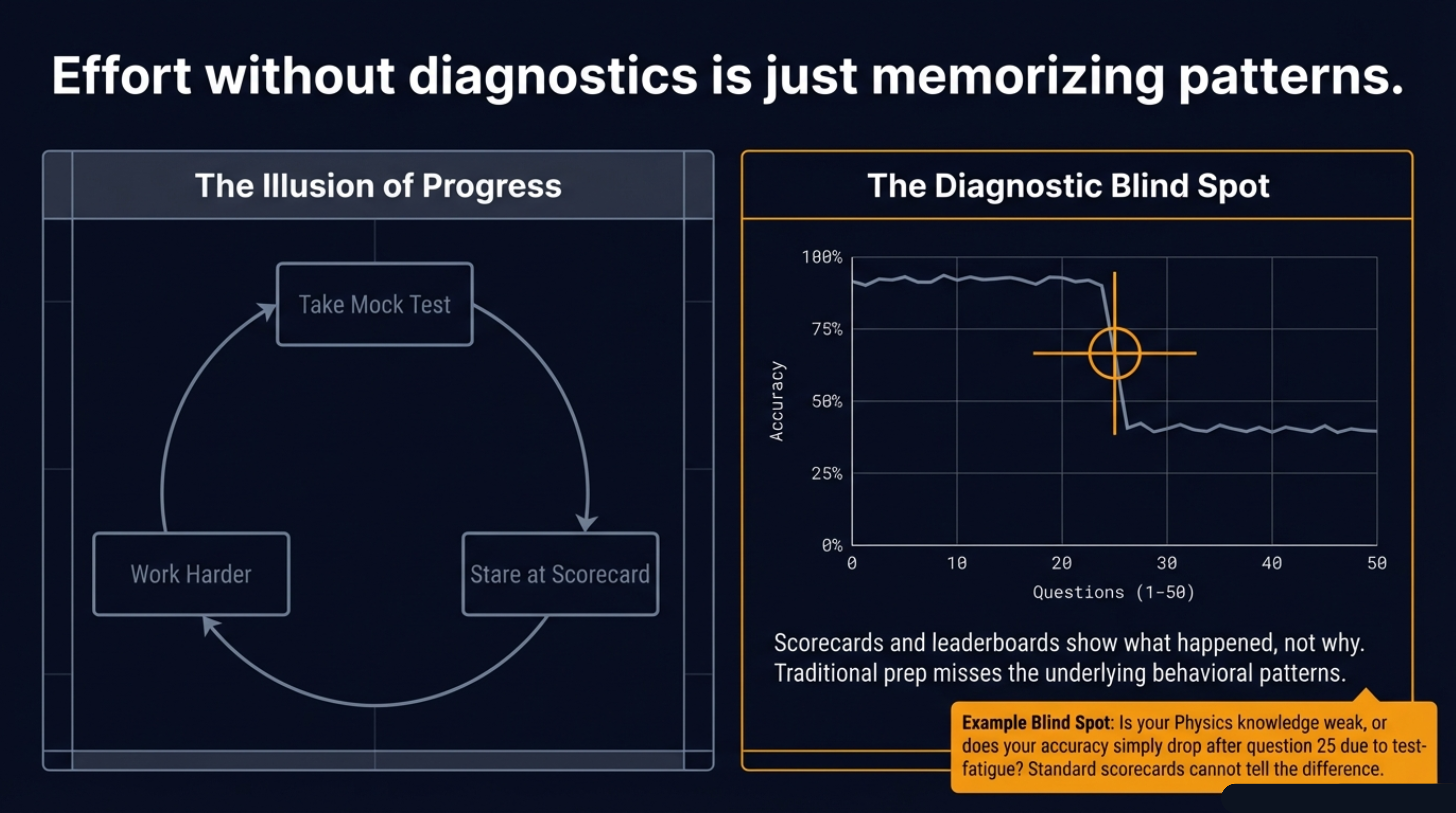
Here is the reality for most NEET and JEE aspirants in India right now: you take mock tests, stare at your scorecard, and wonder whether you are actually improving or just memorising the same patterns. Teachers tell you to "work harder." Coaching apps show you a leaderboard. Neither tells you why you keep losing marks in electrochemistry or why your physics accuracy drops after question 25.
That is where AI-based prediction tools come in. Not the vague, marketing-heavy "AI" that every ed-tech startup slaps on their landing page, but actual models that look at how you solve problems, where you hesitate, and what patterns repeat across your mock tests. The question is: do they work? And more importantly, should you trust them?
This post breaks down what AI prediction for NEET and JEE looks like in 2026, what the research says, what the tools actually do, and where you should be skeptical.
Table of contents
- What does 'AI prediction' actually mean for entrance exams?
- How AI prediction models work for NEET and JEE
- What can AI reliably predict (and what it cannot)
- Real use cases: how students are using these tools today
- The data behind AI in Indian exam prep
- Limitations and honest caveats
- Frequently asked questions
- Final verdict
1. What does 'AI prediction' actually mean for entrance exams?
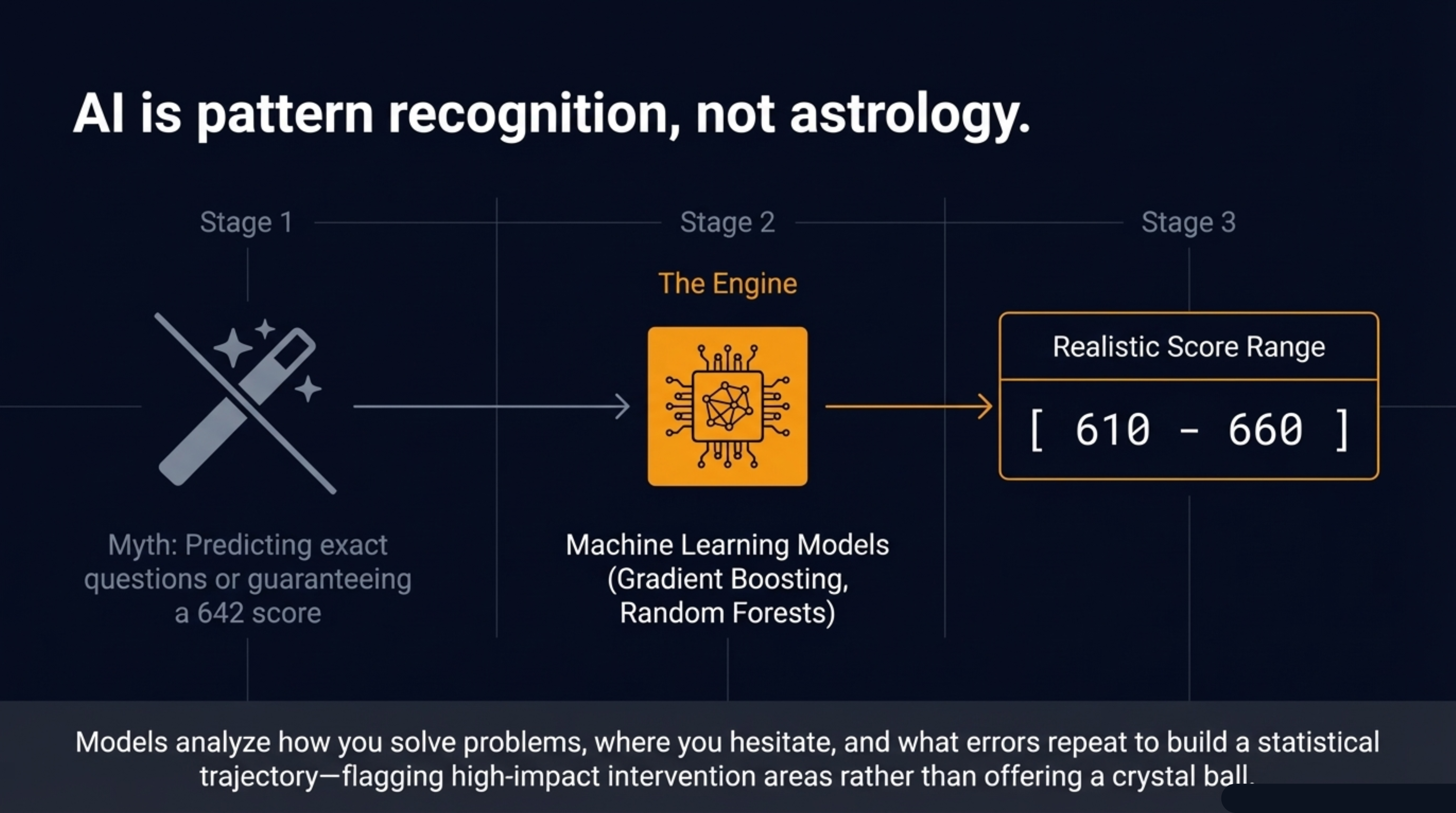
Strip away the buzzwords and here is what is happening: machine learning models analyse your test-taking data (scores, time spent per question, topics attempted, error types) and build a statistical picture of where you are likely to land on exam day.
This is not astrology. It is pattern recognition. If a student consistently scores between 520-560 on full-length NEET mocks, loses 40+ marks on organic chemistry questions, and tends to slow down in the last 30 minutes, a well-trained model can estimate a likely NEET score range and flag specific areas where improvement will have the highest impact on final marks.
The key phrase here is "score range," not exact score. No model will tell you that you will score exactly 642 in NEET 2026. Anyone who claims that is selling something. What a good model does is say: based on your patterns, you are most likely to land between 610-660, and here is what you need to fix to push that range higher.
2. How AI prediction models work for NEET and JEE
Most prediction systems in Indian ed-tech use some combination of the following inputs:
| Data input | What it tells the model |
|---|---|
| Mock test scores (over time) | Trajectory: are you improving, plateauing, or declining? |
| Time spent per question | Where you hesitate, rush, or guess |
| Topic-wise accuracy | Which chapters are strong vs. weak |
| Error classification | Conceptual gaps vs. silly mistakes vs. time-pressure errors |
| Revision frequency | How often you revisit weak areas |
| Difficulty level attempted | Whether you challenge yourself or stay in comfort zones |
The model then uses algorithms (typically gradient boosting, random forests, or neural networks) to find correlations between these inputs and actual exam outcomes. Most platforms train their models on historical data from previous years' test-takers.
For JEE specifically
JEE prediction is trickier because the exam has two stages (JEE Main and JEE Advanced), negative marking, and the percentile-based scoring of JEE Main depends on the entire candidate pool's performance. A good AI model accounts for all of this. A lazy one just averages your mock scores.
The JEE Main qualifying cutoff in 2025 was 93.10 percentile for General/CRL (released April 18, 2025). This was different from 2024's 93.24 and 2023's 90.77 — which is exactly why year-specific calibration matters in any prediction model.
For NEET specifically
NEET is a single-session, pen-and-paper exam (scheduled May 4, 2026). The scoring is absolute (720 marks), so prediction models can be more direct. But NEET's challenge is that the question paper difficulty swings year to year, which makes exact score prediction harder. Models that account for question difficulty variance tend to be more accurate.
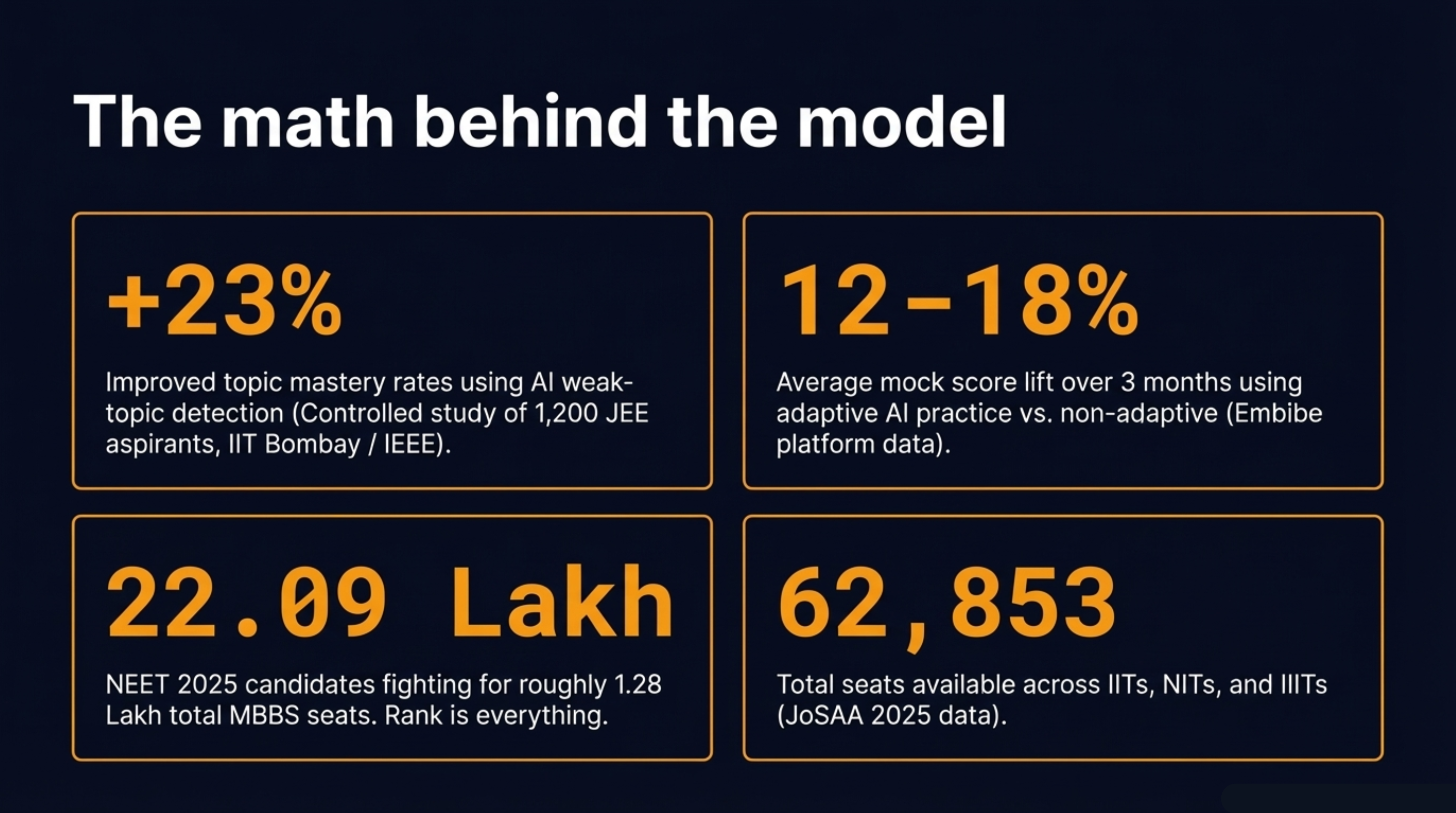
In NEET UG 2025, 22.09 lakh students appeared and 12.36 lakh qualified. The UR/EWS cutoff was 686-144 marks — a significant drop from 2024's 720-162. India now has 1,28,875 MBBS seats across 776+ colleges (per Parliament/NMC data), so your rank matters as much as your score.
3. What can AI reliably predict (and what it cannot)
| AI can reliably do this | AI cannot do this (yet) |
|---|---|
| Estimate your score range based on mock data | Predict the exact questions on exam day |
| Identify your weakest topics with precision | Account for exam-day anxiety or health issues |
| Flag declining performance trends early | Replace a good teacher's intuition about your mindset |
| Recommend personalised revision schedules | Predict NTA's question paper difficulty level |
| Compare your prep level against historical data | Guarantee a rank or college admission |
The honest truth is that AI prediction works best as a diagnostic tool, not a crystal ball. It tells you where you stand, not where you will definitely end up. The gap between the two depends entirely on what you do with the information.
Also Read : JEE & NEET The Integrated Coaching Model
4. Real use cases: how students are using these tools today
Based on what we have seen across platforms and student communities in 2025-2026, here are the most common and most useful ways students use AI prediction tools:
Identifying blind spots
A student might feel confident about Physics because they score well on topic-wise tests. But AI analysis of their full-length mocks might reveal that their Physics accuracy drops significantly when the questions are mixed with Chemistry and Maths (because of time management, not knowledge gaps). That is a blind spot most students do not catch on their own.
Adaptive test recommendations
Instead of solving every chapter equally, AI tools can tell you: "You have already mastered Thermodynamics. Spend that time on Coordination Compounds instead, where your accuracy is 47%." This is basically what a great private tutor does, except the AI can do it with data from hundreds of mock tests, not a hunch.
Score trajectory tracking
Looking at a single mock score in isolation is useless. AI models track your trajectory: are your last 10 mock scores trending up, flat, or down? If they are flat despite more hours of study, the model might flag that you are spending time on topics you already know (a very common mistake in the last 3 months before the exam).
College shortlisting based on predicted score
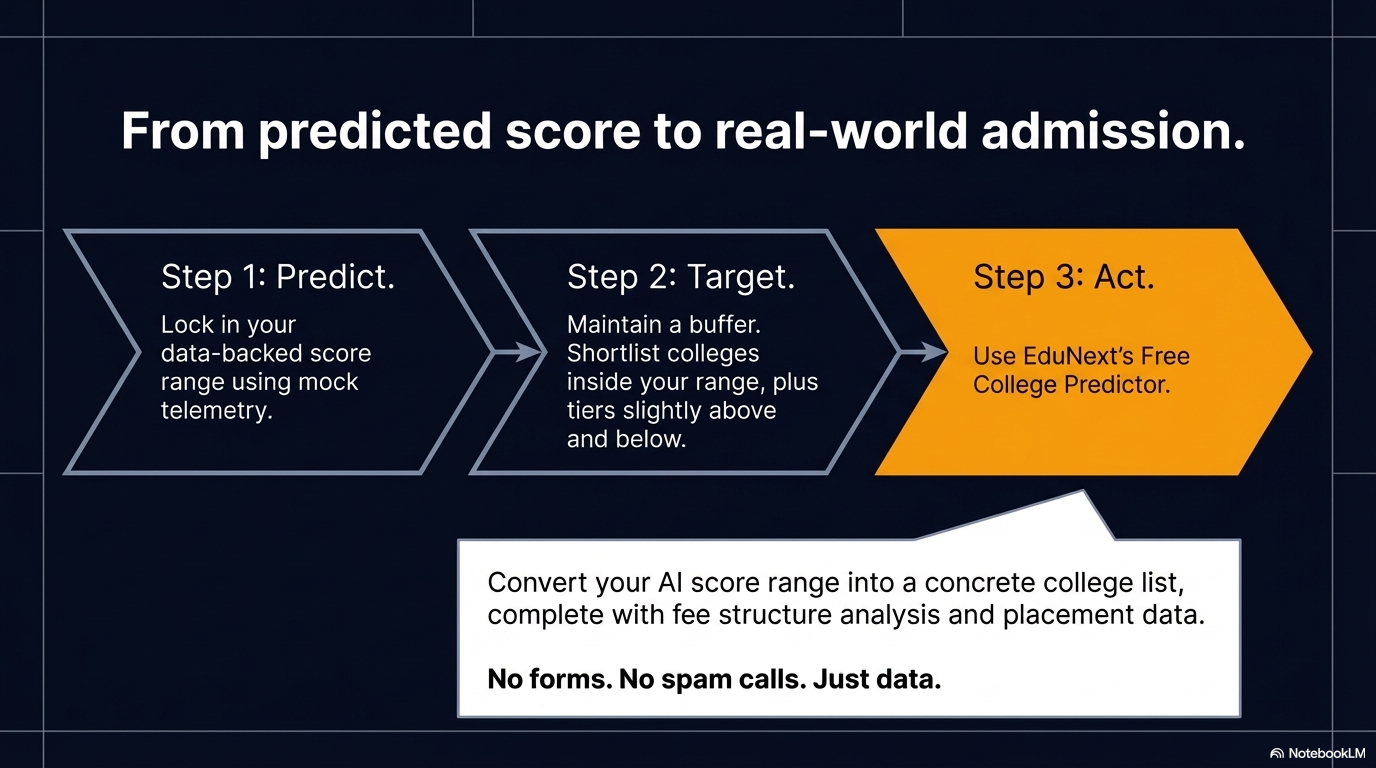
This is where prediction meets practical action. Once you have a predicted score range, you can use tools like EduNext's college predictor to see which colleges you are likely to get into, what the fee structures look like, and what the placement data says. No forms, no spam calls, just data.
5. The data behind AI in Indian exam prep
A few data points worth knowing (these come from published studies and platform reports; verify original sources before citing):
| Finding | Source / context |
|---|---|
| Students using adaptive AI practice scored 12-18% higher on mocks over 3 months vs. non-adaptive practice | Embibe platform data (2024 cohort), self-reported |
| AI-driven weak-topic detection improved topic mastery rates by ~23% in a controlled study of 1,200 JEE aspirants | IIT Bombay research paper (2023), published in IEEE Education |
| Predicted score ranges were within 5% of actual NEET scores for 68% of students who completed 15+ full-length mocks on platform | Allen Digital internal data (2025), shared at Ed-Tech India conference |
| 22.09 lakh students appeared for NEET UG 2025; 12.36 lakh qualified (UR/EWS cutoff: 686-144 marks) | NTA official data, neet.nta.nic.in |
| JoSAA 2025: IITs 18,160 seats, NITs 24,525, IIITs 9,940 — total 62,853 seats | josaa.nic.in |
Take platform-reported data with a grain of salt. These numbers come from companies that have a commercial interest in making their AI tools look effective. The IIT Bombay study is more rigorous, but even that had a limited sample size. The field is still young.
6. Limitations and honest caveats
Before you start treating an AI prediction tool as gospel, here is what you should keep in mind:
Garbage in, garbage out
If you take mocks half-heartedly, skip questions randomly, or cheat (even slightly) during practice tests, the AI model has bad data. Its predictions will be wrong. The model is only as good as the honesty of your practice.
Most platforms overfit to their own tests
A prediction model trained on Platform X's mock tests might not generalise well to the actual NTA exam paper. The question style, difficulty distribution, and topic weightage of coaching platform mocks do not always match the real exam. JEE Main 2025's Session 2 was widely considered harder than most coaching mocks, for instance.
AI cannot model your mental state
Exam-day performance depends on sleep, anxiety, time pressure, and whether the person sitting next to you keeps coughing. AI does not see any of that. A student who scores 650 consistently in mocks might score 600 or 690 on exam day based on factors no model can predict.
The 'last 2 months' problem
Many students make dramatic improvements (or face sharp declines) in the final 2 months before NEET or JEE. Most AI models struggle with sudden trajectory changes because they weight historical patterns. If you are a late bloomer, do not let a conservative AI prediction discourage you.
Also Read : JEE Mini Mock Test 2026
7. Frequently asked questions
Can AI predict my exact NEET 2026 score?
No. AI can give you a probable score range based on your mock test data, but no tool can predict your exact score. The actual exam paper, your mental state on test day, and hundreds of small variables make exact prediction impossible. A score range of plus or minus 30-50 marks is realistic for a well-calibrated model.
Which AI tools are best for JEE Main 2026 score prediction?
Platforms like Embibe, Allen Digital, Vedantu, and PW (Physics Wallah) all have AI-driven analytics built into their mock test systems. The quality varies. Look for tools that give you topic-wise breakdowns, time analysis, and trend tracking rather than just a single number.
Is AI-based prediction reliable enough to choose my target colleges?
Use it as a starting point, not a final answer. If multiple data sources (your mock trends, coaching feedback, and AI prediction) converge on a similar range, that is a reasonably reliable indicator. Always keep a buffer: shortlist colleges in your predicted range AND a few tiers above and below.
Do AI prediction tools work for NEET repeaters/droppers?
Yes, and in some ways they are even more useful for repeaters. If you have a full year's worth of mock data from your previous attempt, the AI has more data points to work with. It can specifically identify whether the topics that cost you marks last year have improved this time around.
Are these AI tools free?
Most platforms offer basic analytics for free with their mock test packages. Advanced features (detailed prediction, personalised schedules, mentor-matching) are typically behind a paywall.
8. Final verdict
AI prediction tools for NEET and JEE have gotten genuinely useful in 2026. They are not magic, and they are not a replacement for putting in the hours. But they are a significant upgrade over the old method of "take a mock, check the score, feel bad, repeat."
The best way to use them: take your mock tests seriously, let the AI do the pattern analysis, focus your remaining prep time on the specific weaknesses it identifies, and then use a tool like EduNext's college predictor to convert your predicted score into a real action plan.
Because knowing your likely score is only half the job. Knowing which colleges match that score, what they cost, and whether they are worth it is the other half.