In-School JEE & NEET Preparation: The Integrated Coaching Model
Blog
Leave your details and our counselors will reach out to you shortly.
🎧 Listen to this article
In-School JEE & NEET Preparation: The Integrated Coaching Model
Traditionally, cracking India’s toughest entrance examinations such as the Joint Entrance Examination and the National Eligibility Cum Entrance Test has meant students having to juggle school and external coaching classes. This has meant a life of constant traveling and an overwhelming academic load for many students.
However, over the last few years, a highly effective new method of cracking these entrance examinations has emerged and is revolutionizing the way students are preparing for these highly competitive examinations – Integrated Coaching Model, or in-school JEE/NEET preparation.
Rather than having a separate school and coaching education, this model has both integrated into a single education framework. This model has become a blessing for thousands of students seeking admission into top Indian institutes such as the Indian Institutes of Technology and the All India Institute of Medical Sciences.
In this comprehensive guide by EduNext, we will cover everything that you need to know about the integrated coaching model for 2026 and beyond.
Understanding JEE and NEET: Scope and structure
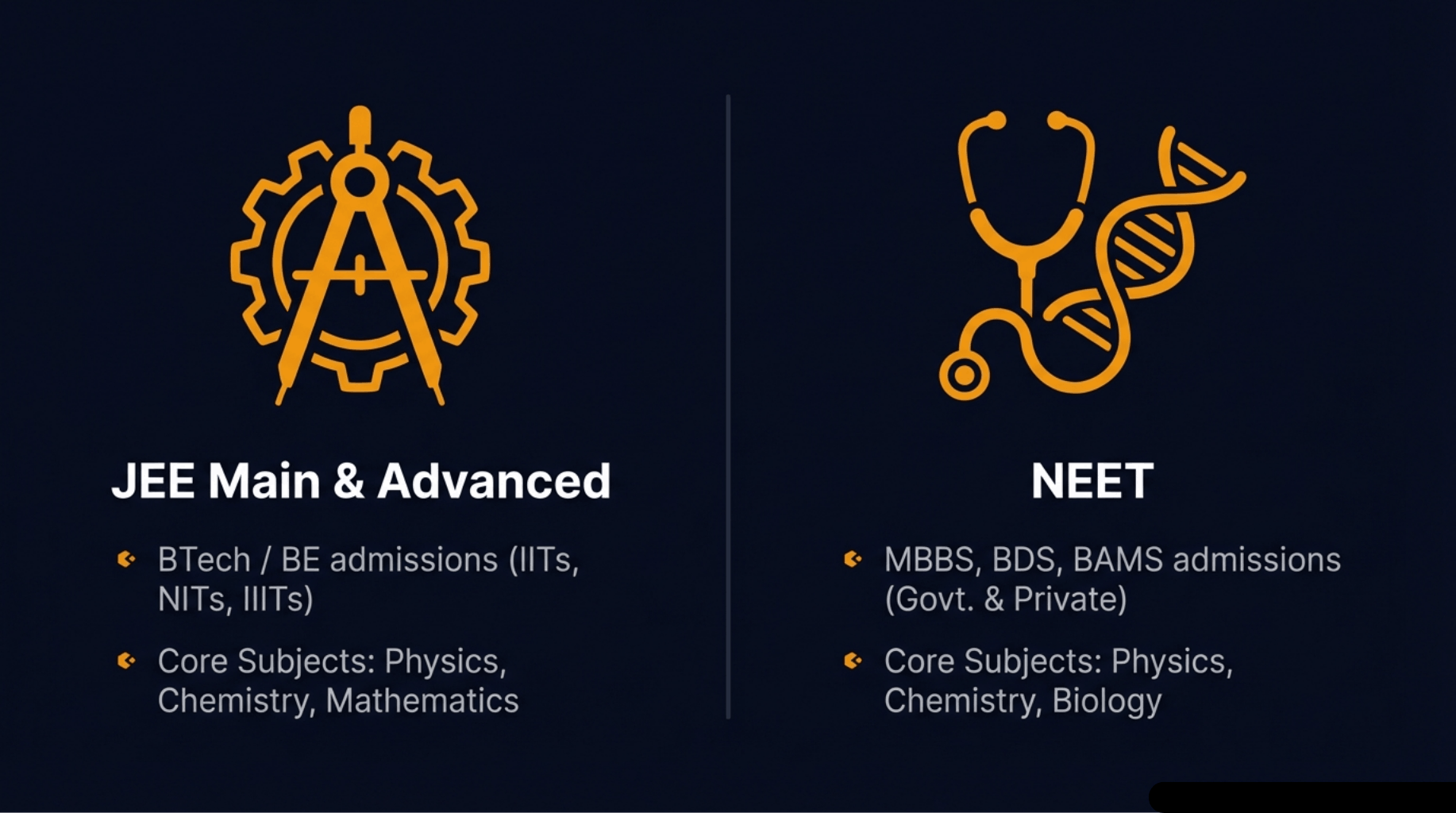
JEE is the entrance examination for undergraduate courses in engineering, such as BTech or BE. JEE is divided into two parts: JEE Main and JEE Advanced. JEE Advanced is required for admission to Indian Institutes of Technology, whereas JEE Main is valid for National Institutes of Technology, Indian Institutes of Information Technology, and other private institutions.
NEET is an entrance examination for undergraduate courses such as MBBS, BDS, BAMS, BVSc, and BHMS. NEET is required for all government and private medical colleges. About NTA JEE News & Updates
Subjects and Syllabus
JEE Main and Advanced: Physics, Chemistry, and Mathematics NEET: Physics, Chemistry, and Biology
Understanding the NEET Exam Pattern
There is a huge difference between the NEET and board exam patterns. The NEET entrance is based on multiple-choice questions, whereas board exams are theoretical. Here is the exam pattern for both NEET and board exams:
| Particulars | Class 12 Board Exam | NEET Exam |
|---|---|---|
| Time Duration | 3 Hours | 3 Hours 20 Minutes |
| Exam Pattern | Subjective Type | Multiple Choice Questions (MCQs) and Numerical Based Questions |
| Subjects | More than 3 (including Biology, Physics, and Chemistry) based on your board | Biology, Physics, and Chemistry |
| Difficulty Level | Moderate (Students can easily solve the paper) | Difficult (With practice and concepts, students can easily crack the paper) |
| Marking Scheme | Questions from each section have different marks | +4 for the correct answer, −1 for incorrect answer |
Understanding the JEE Exam Pattern
To excel in your studies and JEE, it is essential that you are aware of the exam pattern, syllabus, marking scheme, level of difficulty, topic-wise weightage, and other details concisely for both the exams. There is a crystal-clear difference between the Board Exam and JEE, which is given below:
| Particulars | 12th Board Exam | JEE Exam |
|---|---|---|
| Exam Pattern | Objective Type Exam | Multiple Choice Questions & Numerical Value Type |
| Syllabus | Only 12th Class Syllabus | 11th & 12th Class Syllabus |
| Subjects | More than 3 including Physics, Chemistry, and Maths based on your Board and Medium | Only 3: Physics, Chemistry, and Maths |
| Difficulty Level | Moderate. Even average students can score well. | Highly High. Only those students will qualify who have a thorough knowledge and understanding of the concepts. |
| Negative Marking | No Negative Marking | -1 Negative Marking will be given for each wrong answer |
📌 Related Read: JEE Main 2026
📌 Related Read: Beyond the Boards
Why Traditional Coaching Is Becoming Difficult for Students
Traditionally, the format for succeeding in exams such as the JEE or NEET has been as follows:
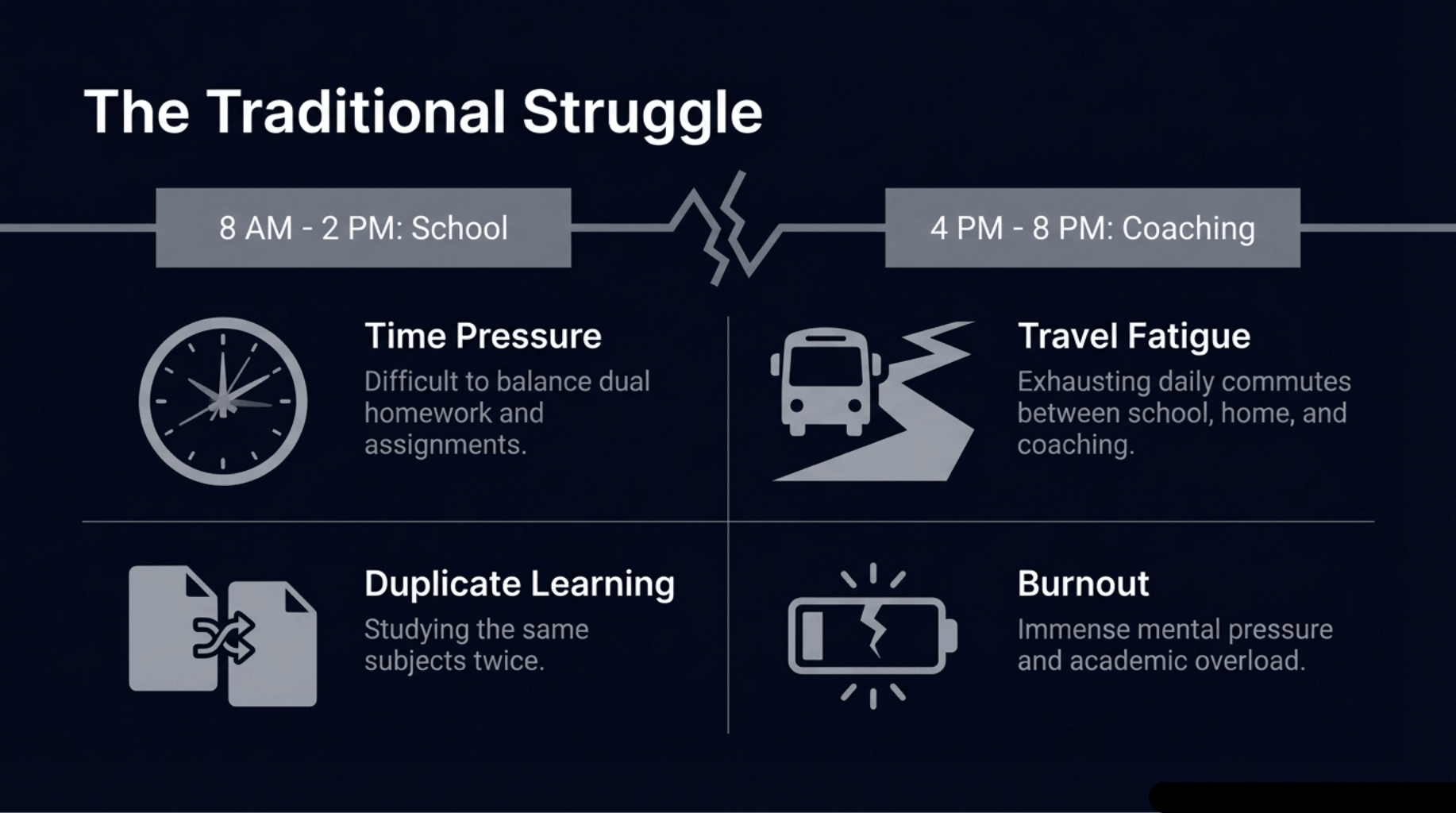
Schooling from 8 AM to 2 PM Coaching classes from 4 PM to 8 PM Studying and doing homework at night
Though this format has been successful for many students it has also led to a number of issues for them.
Common Problems Students Face
| Challenge | Explanation |
|---|---|
| Time Pressure | Students find it difficult to balance their homework and assignments with their coaching homework and assignments. |
| Travel Fatigue | Students travel long distances to attend coaching classes, and this is becoming a problem for many. |
| Duplicate Learning | Students are learning many subjects twice, once in school and once in coaching classes. |
| Burnout | Students are under a lot of pressure and are burning out mentally. |
To solve all of these issues schools and coaching classes began to join hands together.
What Is the Integrated Coaching Model?
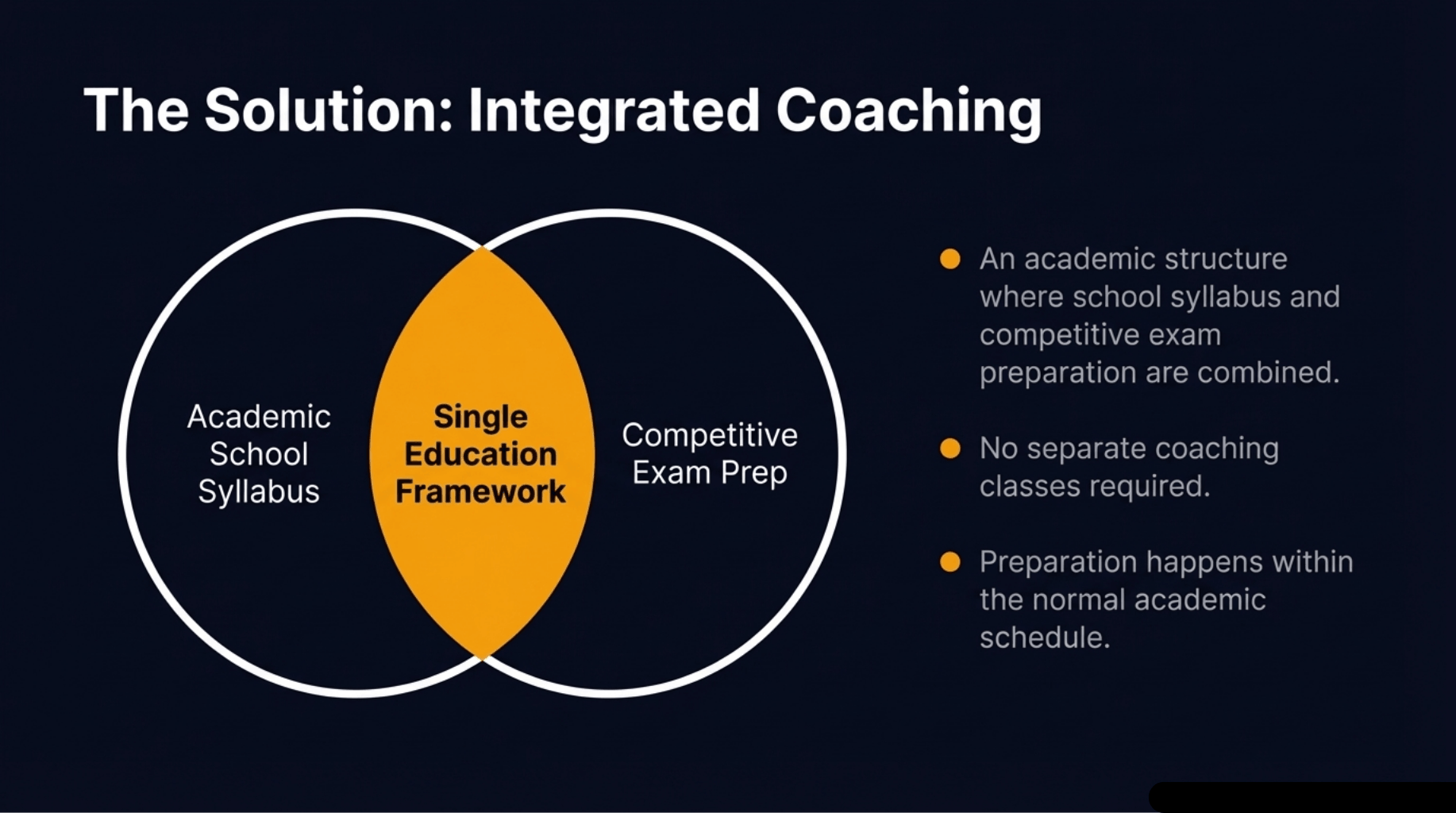
The Integrated Coaching Model is an academic structure wherein the academic syllabus of a school and the preparation for competitive exams are included in the same academic course structure.
Students will no longer need to attend separate coaching classes for competitive exams, as the academic syllabus will include the preparation for competitive exams such as the JEE or NEET, as per the academic schedule of the school.
Key Features of Integrated Coaching
| Feature | Description |
|---|---|
| Unified Curriculum | The academic syllabus and the competitive exams will be included in the same course structure. |
| Expert Faculty | The academic staff will include expert teachers for competitive exams such as the JEE or NEET. |
| Regular Mock Tests | The students will be provided with regular mock tests for competitive exams. |
| Performance Analytics | The performance of the students will be tracked using analytics. |
| Reduced Travel | The academic classes will take place within the academic campus of the school. |
| This model ensures students learn concepts once but master them thoroughly. |
How In-School JEE & NEET Preparation Works
Typically, integrated programs begin from Class 11, when actual preparation for engineering and medical entrance exams commences.
Here is how it works:
 1. Synchronized Curriculum
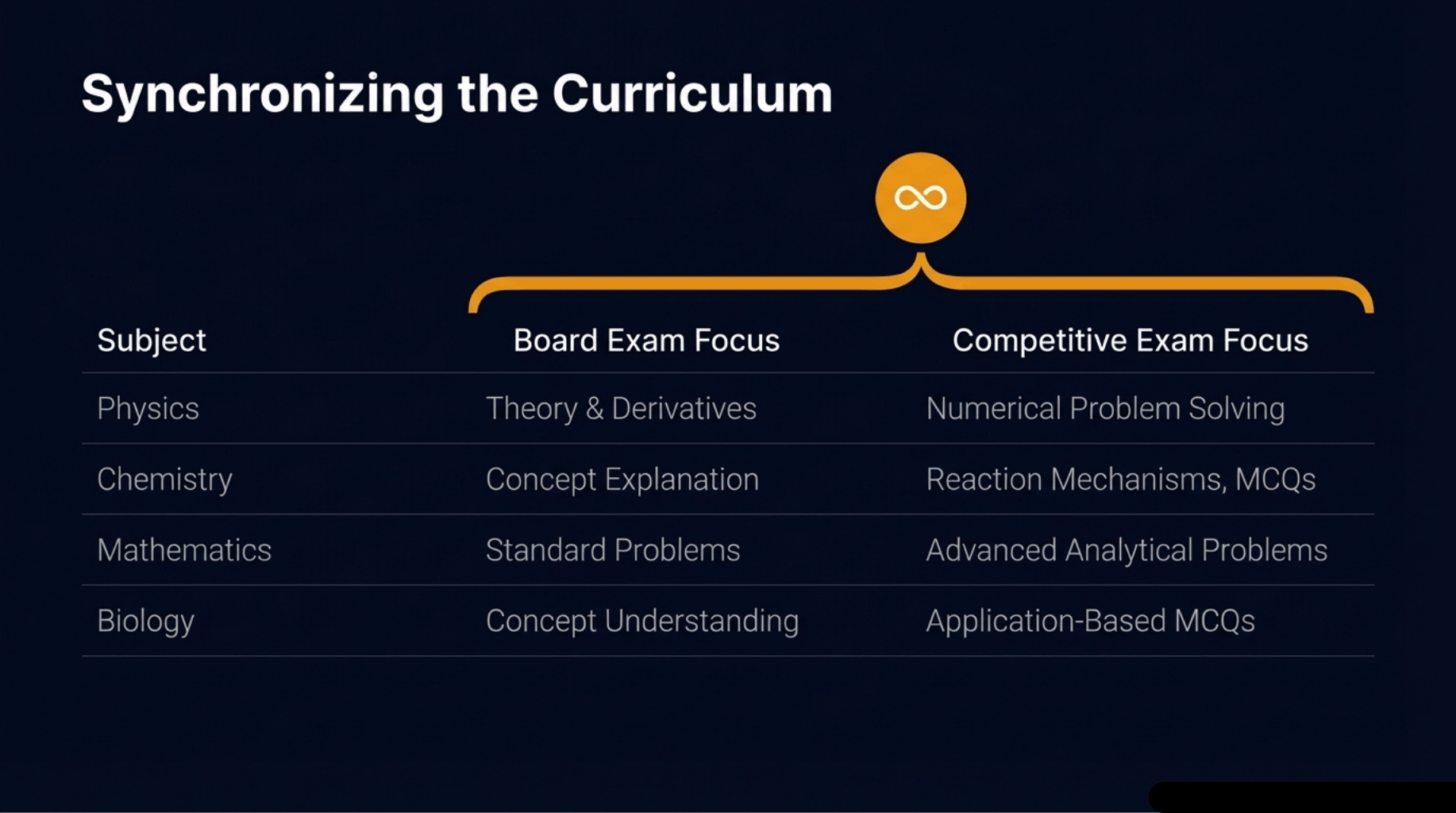
One of the major benefits of integrated coaching is that the school curriculum is synchronized with the competitive entrance exam syllabus, so a student doesn’t need to study a particular subject twice, i.e., once for the board exam and once for the entrance exam.
1. Synchronized Curriculum
One of the major benefits of integrated coaching is that the school curriculum is synchronized with the competitive entrance exam syllabus, so a student doesn’t need to study a particular subject twice, i.e., once for the board exam and once for the entrance exam.
Example: Let’s consider a student studying physics, chemistry, mathematics, or biology. The topics covered in the board exams would be different from the topics covered in the competitive entrance exams.
| Subject | Board Exam Focus | Competitive Exam Focus |
|---|---|---|
| Physics | Theory and Derivatives | Numerical Problem Solving |
| Chemistry | Concept Explanation | Reaction Mechanisms, MCQs |
| Mathematics | Standard Problems | Advanced Analytical Problems |
| Biology | Concept Understanding | Application-Based MCQs |
2. Specialized Faculty for Competitive Exams Another significant advantage is that teachers are trained to teach competitive exams like:
- Joint Entrance Examination – Advanced
- National Eligibility cum Entrance Test
Teaching styles are focused on helping the student:
- Solve complex problems
- Understand the exam pattern
- Manage time
- Learn shortcuts
- Learn techniques
 3. Continuous Testing System
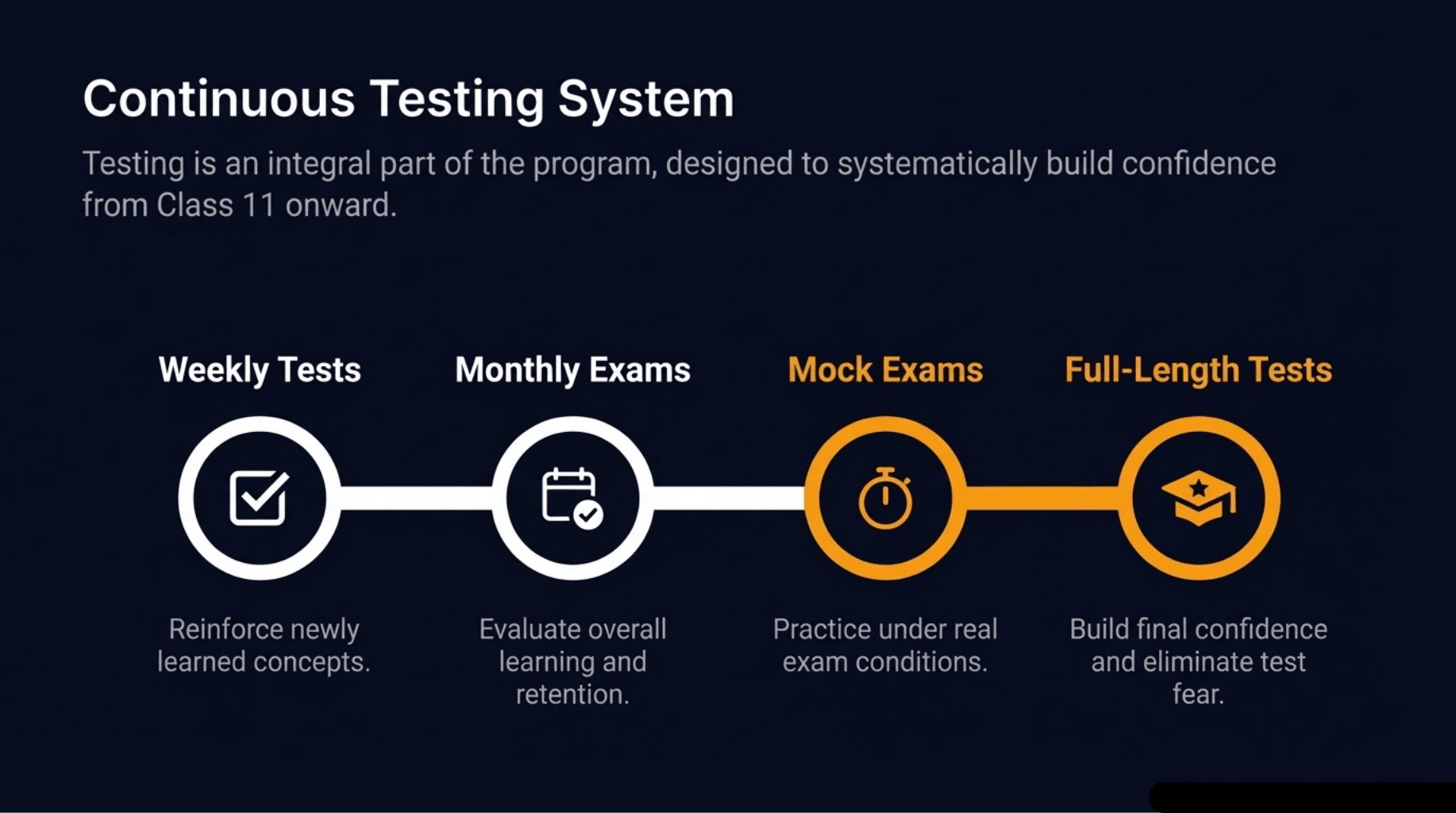
Testing is an integral part of the integrated program.
3. Continuous Testing System
Testing is an integral part of the integrated program.
Students are given various forms of tests.
| Test Type | Purpose |
|---|---|
| Weekly Tests | To reinforce the newly learned concepts |
| Monthly Exams | To test the overall learning of the concepts |
| Mock Exams | To test the students under real conditions |
| Full-Length Tests | To test the students under real conditions |
Such testing helps the students gain confidence and overcome the fear of the test.

How EduNext Helps Students Select the Right Integrated Coaching Program
Selecting the right integrated coaching program for the right career can sometimes prove to be confusing for students as well as parents.
EduNext, an admission consultancy that serves the needs of Indian students, helps students select the right integrated coaching program for their career.
EduNext’s mission is to guide students through the complex education system in an honest and transparent manner.
The Future of Integrated Coaching in India
As the competition for admissions into the country’s top institutions, including the Indian Institutes of Technology and the All India Institute of Medical Sciences, continues to increase, the growth of the integrated coaching system is expected to skyrocket.
As the education system evolves, more schools are collaborating with coaching institutes, new hybrid models of digital learning are emerging, and the trend of tracking performance through data is becoming increasingly popular.
The integrated coaching system is expected to become the new normal for the country’s toughest exams.
FAQs
1. What is the Integrated Coaching Model for JEE & NEET?
The Integrated Coaching Model is an education system in which the regular school curriculum is combined with the study of competitive exams like the Joint Entrance Examination and the National Eligibility cum Entrance Test.
2. Is the Integrated Coaching Model better than the traditional coaching model?
Yes, the Integrated Coaching Model is better because it saves time and reduces the burden of the school curriculum compared to the traditional coaching model.
3. When should students start preparing for JEE/NEET?
Students usually start preparing for the Joint Entrance Examination and the National Eligibility cum Entrance Test from Class 11. However, building concepts from Class 9 and 10 will be beneficial for the Joint Entrance Examination and the National Eligibility cum Entrance Test.
4. What subjects should I focus on for JEE?
Students should focus on the following subjects for the Joint Entrance Examination: Physics Chemistry Mathematics
5. What subjects are required for NEET preparation?
The subjects that need to be focused on by a student who wants to prepare for the National Eligibility cum Entrance Test are: Physics Chemistry Biology Biology has the maximum weightage in this exam.
6. Do integrated programs help reduce student stress?
Yes, it does, since studies at school and coaching for the entrance exam are integrated, so a student has to follow a single schedule, which reduces pressure on the student.
7. How does EduNext help students with integrated coaching programs?
EduNext helps a student choose the best school that offers integrated coaching programs for competitive exams. This platform offers guidance to a student regarding the best school that offers integrated coaching programs.
8. Can students still take external coaching along with integrated programs?
Yes, it is possible, but the integrated programs are so designed that a student does not need any extra coaching to appear for the Joint Entrance Examination or the National Eligibility cum Entrance Test.