Private Medical College Fees 2026-27: What MBBS Actually Costs Beyond the Brochure
Blog
Leave your details and our counselors will reach out to you shortly.
Private Medical College Fees 2026-27: What MBBS Actually Costs Beyond the Brochure
Key Takeaways
- Private medical college MBBS fees for the 2026-27 admission cycle range enormously — from around ₹15 lakh/year at the cheaper end of management quota to ₹40–45 lakh/year at premium deemed universities.
- A full 5.5-year MBBS (including internship) at a private college can total anywhere from ₹75 lakh to over ₹1.5 crore, depending on the college and quota.
- Karnataka has among the highest management-quota fees in India (₹27–45 lakh/year), while Kerala remains comparatively the most regulated and affordable for management-quota seats.
- NRI quota fees run considerably higher than management quota — typically ₹18–50 lakh per year, sometimes quoted in USD.
- The brochure figure is rarely the real cost — hostel, mess, caution deposits, and annual fee escalation clauses can meaningfully change your actual 5.5-year total.
For the 2026-27 admission cycle, ask five different families what MBBS costs at a private college and you'll get five different answers — and none of them are wrong. Private medical education in India runs on multiple parallel fee tracks: government-quota seats within private colleges (regulated and comparatively affordable), management-quota seats (set largely by the institution, within state fee-committee caps), NRI-quota seats (the highest tier, often benchmarked in USD), and deemed-university seats, which frequently fall outside state fee regulation entirely and can run into ₹1 crore-plus for the full course.
Understanding which quota you're being quoted for — and whether that number is per year or for the full course — is the single most important thing to clarify before treating any fee figure as reliable.
EduNext tip: Always ask a college for its fee under NEET counselling (MCC/state quota) versus institutional/management quota separately. The two numbers on the same seat can differ by lakhs per year.
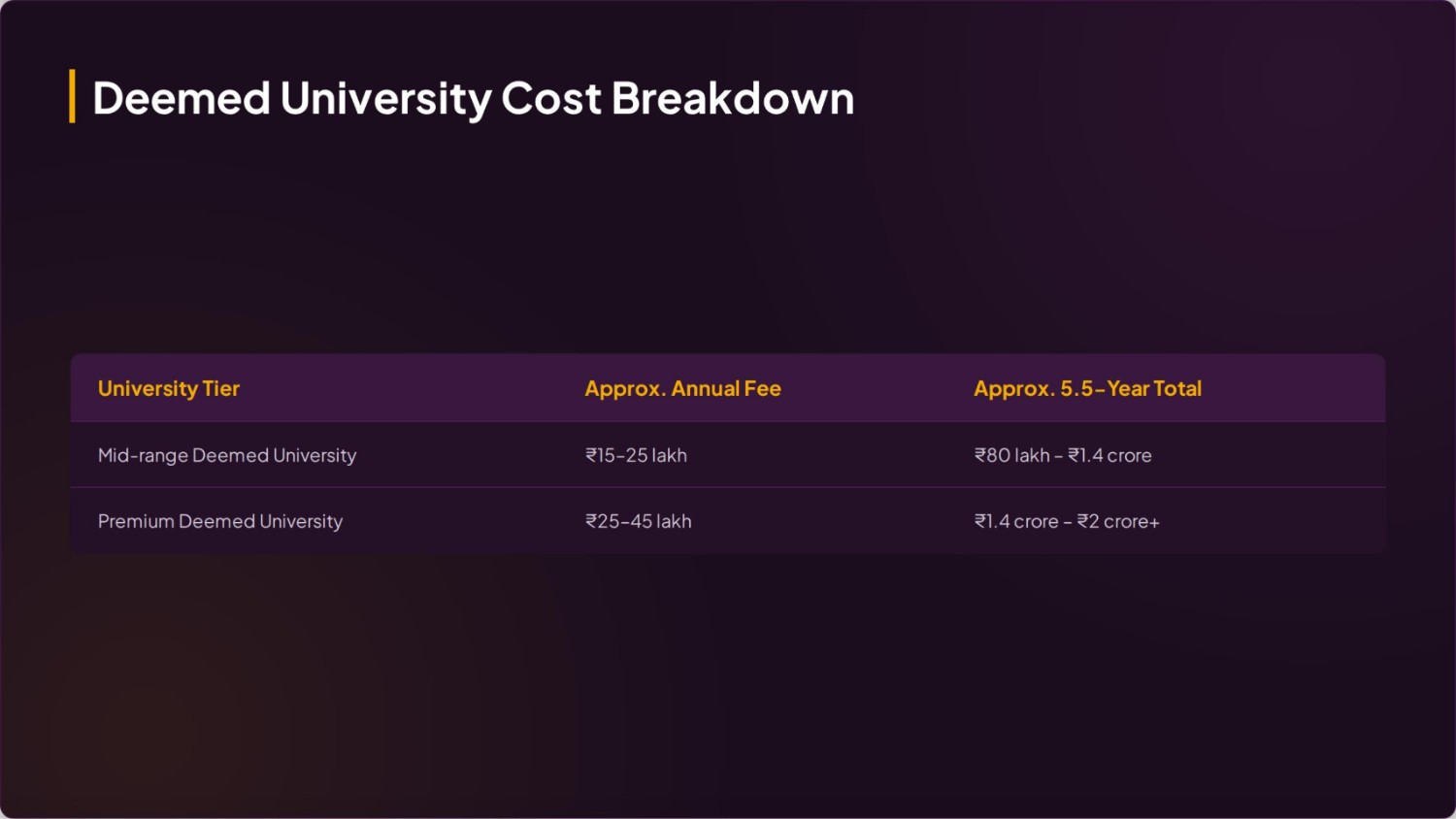
Deemed universities sit at the top of the private MBBS fee bracket, and 2026-27 data shows notified first-year fees ranging from roughly ₹17.8 lakh to ₹28.6 lakh across institutions, with several premium deemed universities charging ₹25–45 lakh per year. Across a 5.5-year course, this routinely pushes total cost past ₹1 crore, and some of the priciest deemed institutions cross ₹1.5 crore for the complete degree once hostel and other charges are added.
| Fee Tier | Approx. Annual Fee (Deemed Universities) | Approx. 5.5-Year Total |
|---|---|---|
| Mid-range deemed university | ₹15–25 lakh | ₹80 lakh–₹1.4 crore |
| Premium deemed university | ₹25–45 lakh | ₹1.4 crore–₹2 crore+ |
Compare verified medical college fees before you commit, on EduNext
Management quota fees vary significantly by state, largely due to differing state fee-regulation committees. Here's the broad 2026-27 picture:
| State/Region | Management Quota Fee (per year, approx.) | Notes |
|---|---|---|
| Karnataka | ₹27–45 lakh | Among the highest in India for the 2026-27 cycle |
| Maharashtra | Varies by college, state fee committee regulated | Mid-to-high range |
| West Bengal / Bihar (tier-2 colleges) | ₹8–10 lakh | Comparatively lower entry point |
| Kerala | Lower and more tightly regulated | Considered the most affordable management-quota state |
The lowest verified management-quota annual fee found in recent data was around ₹2.11 lakh at a specific institution (MGIMS Sevagram, Wardha), while the highest management-quota fee among deemed universities has reportedly touched ₹22.5 lakh per year — illustrating just how wide the spread is even within the same quota category.
Honest trade-off: A "cheap" management-quota seat in one state can still cost more over 5.5 years than a mid-priced deemed-university seat elsewhere, once you factor in annual fee escalation. Always calculate the full-course total, not just year one.
NRI quota sits above both government and management quota in cost, typically priced at ₹15–50 lakh per year, with some colleges quoting fees directly in USD. A few states, such as Himachal Pradesh, have comparatively lower NRI quota fees (around $20,000/year), making them exceptions rather than the rule. For most private colleges, NRI quota seats are priced with the expectation that the paying family holds foreign income, and negotiating this fee down is rare.
| Quota Type | Typical Annual Fee Range |
|---|---|
| Government quota (within private college) | Regulated, closer to government-college fees |
| Management quota | ₹15–45 lakh, state-dependent |
| NRI quota | ₹15–50 lakh, sometimes in USD |
The headline tuition figure is rarely the full picture. Before signing on, account for:
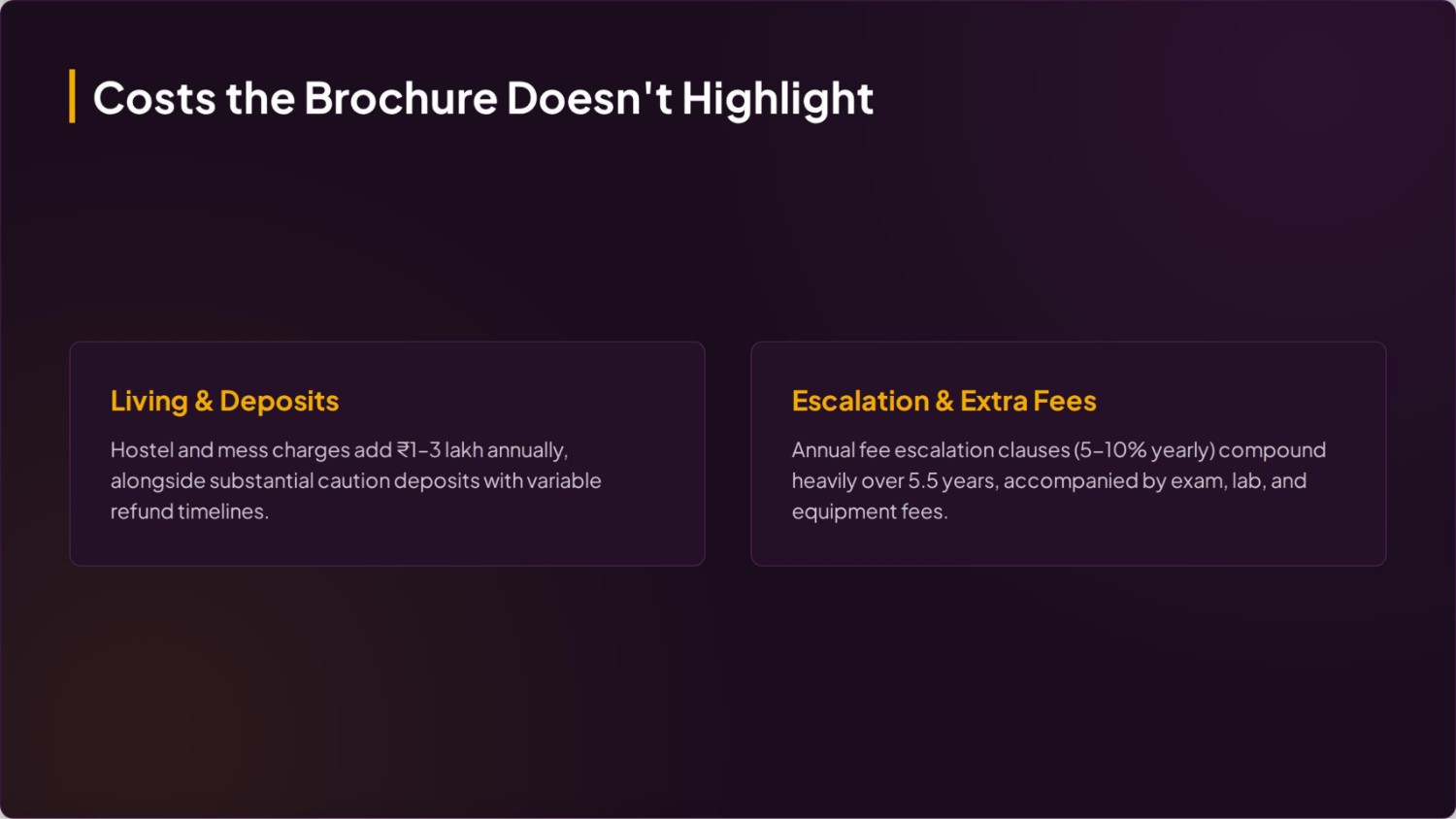
- Hostel and mess charges — often billed separately and can add ₹1–3 lakh/year.
- Caution deposits and refundable securities — sometimes substantial, and refund timelines vary by institution.
- Annual fee escalation clauses — some colleges increase fees by 5–10% every year, which compounds significantly over 5.5 years.
- Additional academic charges — exam fees, uniform/equipment costs, and library or lab charges that aren't always bundled into the quoted tuition.
A fee quoted at ₹20 lakh/year can realistically cost ₹23–24 lakh/year once these are added — multiply that gap across 5.5 years and the difference becomes serious money.
- Check the state fee-regulation committee's approved fee for that specific college and quota — this is the only legally binding figure, not the brochure number.
- Ask for a full 5.5-year cost breakdown in writing, including hostel, mess, and any escalation clause, before paying any deposit.
- Confirm which counselling route the seat is under — MCC All India Quota, state quota, management quota, or NRI quota — since fees differ sharply across these even within the same college.
- Cross-check with NMC-recognised college status — an unrecognised or provisionally-approved institution carries risk regardless of how competitive its fee looks.
What is the cheapest way to get an MBBS seat at a private college in 2026-27?
Government-quota seats within private colleges, allotted through MCC or state counselling based on NEET rank, are the most affordable route — far cheaper than management or NRI quota at the same institution.
Which state has the highest management quota MBBS fees in 2026-27?
Karnataka currently has among the highest management-quota fees in India, ranging from approximately ₹27 lakh to ₹45 lakh per year.
Are deemed university MBBS fees regulated like state private colleges?
Not always. Many deemed universities fall outside state fee-committee regulation, which is a key reason their fees can run significantly higher — sometimes over ₹1 crore for the full course.
How much more expensive is NRI quota compared to management quota?
NRI quota fees typically run ₹15–50 lakh per year, similar to or sometimes exceeding the higher end of management quota, and are usually not open to negotiation.
What extra costs should I budget for beyond tuition?
Hostel and mess fees, caution deposits, annual fee escalation, and additional academic charges (exams, equipment, lab fees) can meaningfully raise your real cost beyond the quoted tuition figure.
Conclusion
"Private medical college fees" isn't a single number for the 2026-27 cycle — it's a spread that runs from a manageable ₹15 lakh/year to well over ₹40 lakh/year depending on quota, state, and whether the institution is a regulated private college or an unregulated deemed university. The only way to make a sound decision is to get the full 5.5-year cost in writing, confirm which quota and counselling route applies, and verify the college's NMC recognition before any payment changes hands.
Comparing private medical colleges before you decide? Check verified fees, quotas and reviews across colleges on EduNext — zero spam calls, guaranteed → getedunext.com