VIT vs SRM vs Manipal vs Amity vs KIIT: Which Private University Is Worth the Fee
Blog
Leave your details and our counselors will reach out to you shortly.
VIT vs SRM vs Manipal vs Amity vs KIIT: Which Private University Is Worth the Fee
Key Takeaways
- On NIRF 2025 Engineering, SRM ranks 14th, VIT 16th, and KIIT 36th nationally — Manipal Institute of Technology also slipped a few places from the previous year.
- VIT Vellore's B.Tech fee (₹1.7–2 lakh/year) is dramatically lower than SRM (
₹4.5 lakh/year), Manipal (₹5 lakh/year), KIIT (₹4.4–4.6 lakh/year), and Amity Noida (₹3.6–4.4 lakh/year, rising ~10% annually). - VIT reports the strongest placement numbers among the five — average package around ₹9.9 LPA and highest offers touching ₹88 LPA in recent cycles.
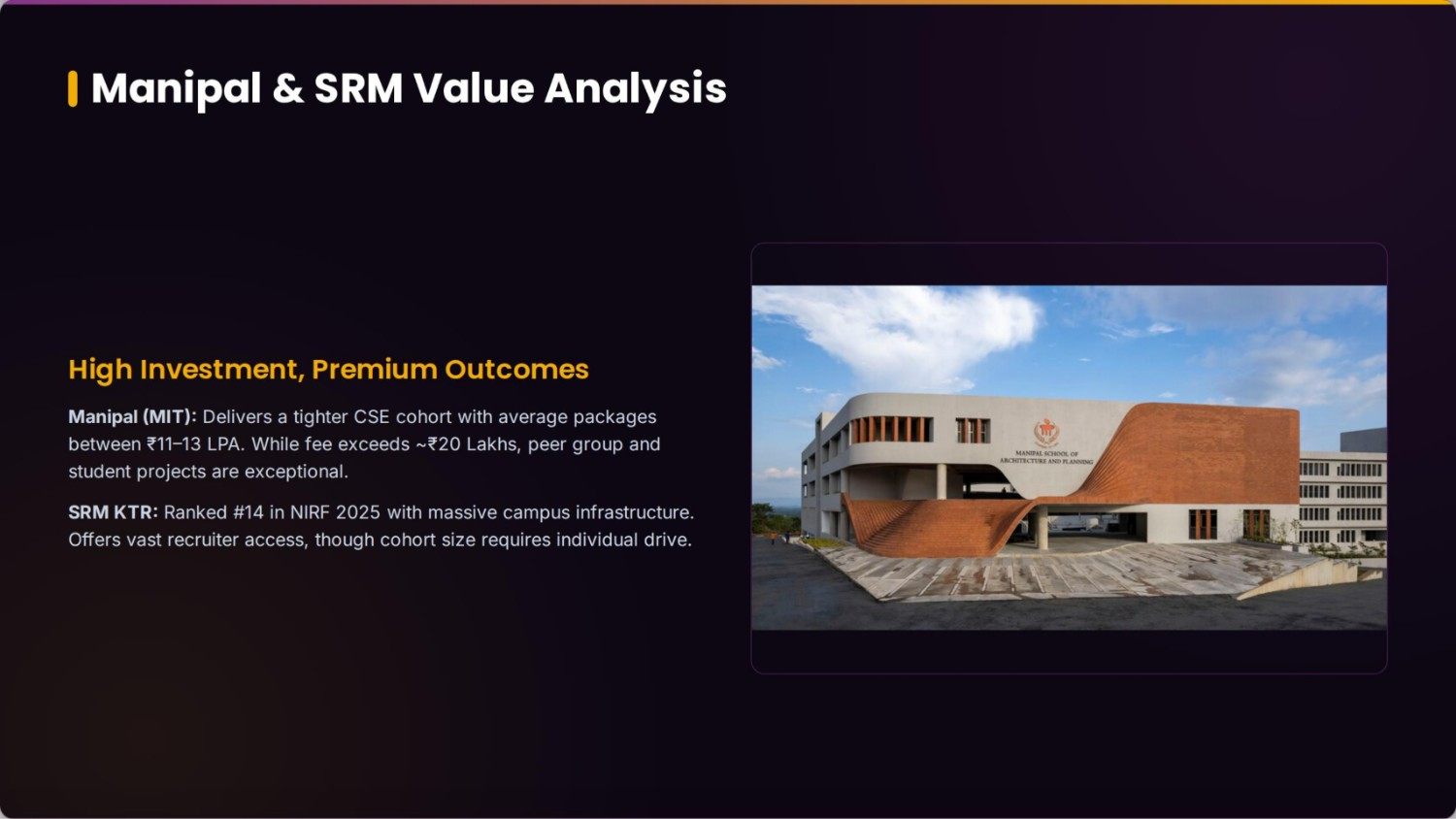
- Manipal delivers a smaller, tighter-knit CSE cohort with average packages around ₹11–13 LPA, but at nearly 3x VIT's fee.
- "Worth the fee" depends on branch and campus, not just brand — CSE at the flagship campus of each university consistently outperforms other branches and satellite campuses.
VIT, SRM, Manipal, Amity and KIIT dominate India's private engineering search results for a reason: each has built a recognisable brand, a large campus, and consistent placement marketing. But "worth the fee" is a specific, answerable question — not a vibe. It comes down to three numbers: what you pay per year, where the university sits on NIRF, and what the median (not just the highest) placement package looks like for your specific branch and campus.
This comparison uses NIRF 2025 rankings, the most recent publicly available fee structures for B.Tech CSE (the most competitive and highest-fee branch at all five), and recent placement data to give you a straight answer rather than a marketing one.
EduNext tip: Always compare the median placement package, not the highest one quoted on a university's website. A single ₹88 LPA offer says nothing about what the average student in your branch actually earns.
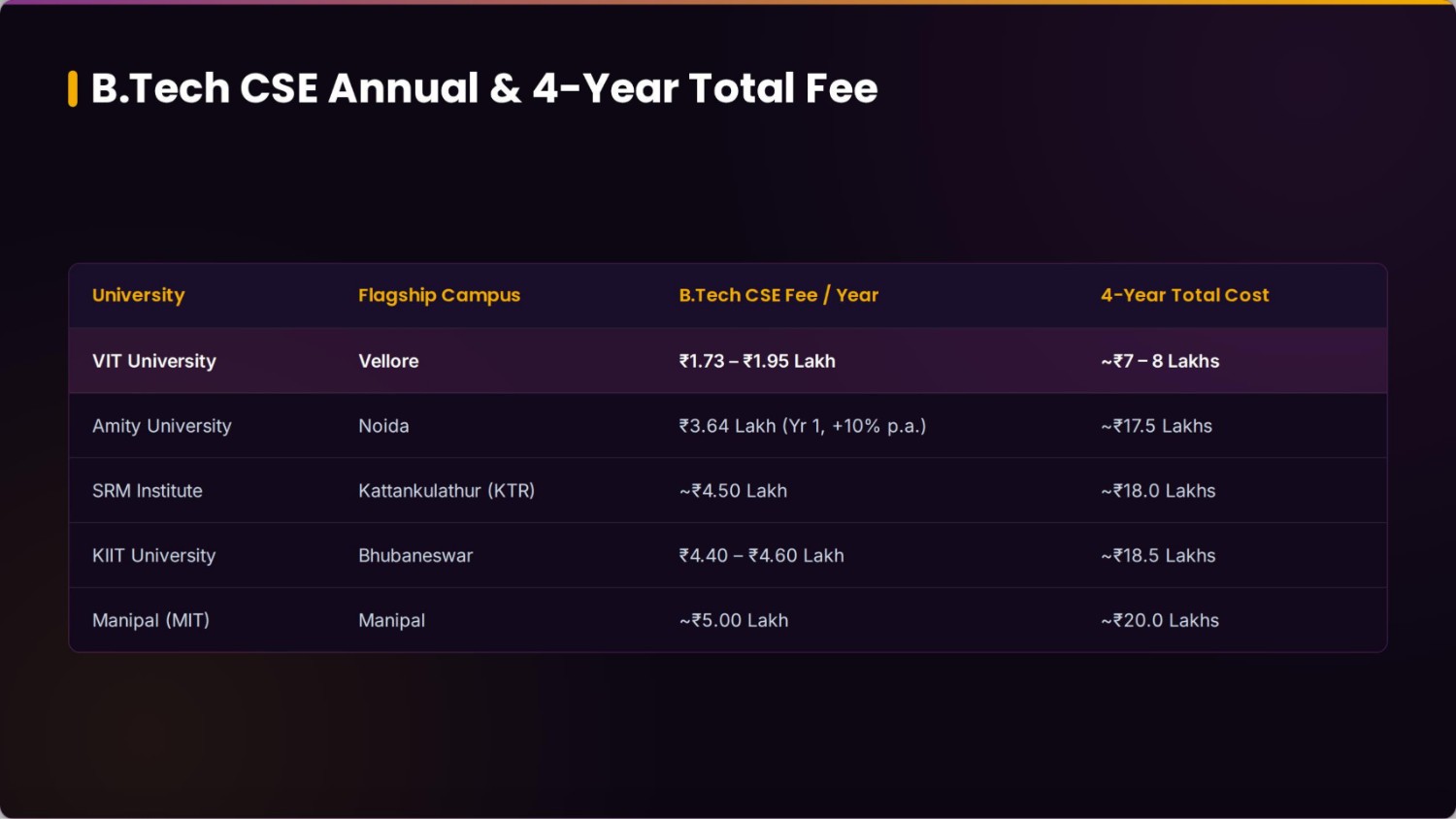
Fees vary by campus within the same university, so figures below reflect each institution's flagship or most commonly referenced CSE campus.
| University | Flagship Campus | B.Tech CSE Fee (per year, approx.) | 4-Year Total (approx.) |
|---|---|---|---|
| VIT | Vellore | ₹1.73–1.95 lakh | ₹7–8 lakh |
| Amity University | Noida | ₹3.64 lakh (Year 1, ~10% annual rise) | ~₹17.5 lakh |
| KIIT | Bhubaneswar | ₹4.4–4.6 lakh | ~₹18.5 lakh |
| SRM | Kattankulathur (KTR) | ~₹4.5 lakh | ~₹18 lakh |
| Manipal (MIT) | Manipal | ~₹5 lakh | ~₹20 lakh |
The gap is stark: VIT's total CSE cost over four years is roughly half to a third of what SRM, KIIT, Manipal or Amity charge for the same degree length. That single fact reframes the entire "worth it" conversation before rankings or placements even enter the picture.
Compare exact fee structures and scholarships across these universities on EduNext
| University | NIRF 2025 Engineering Rank | NIRF Score |
|---|---|---|
| SRM Institute of Science and Technology | 14 | 65.83 |
| VIT (Vellore) | 16 | 65.25 |
| KIIT University | 36 | 58.61 |
| Manipal Institute of Technology | Slipped a few places vs. 2024 | — |
| Amity University | Not consistently in the engineering top 50 | — |
SRM edges VIT by rank in NIRF 2025, though the two remain closely matched on score. KIIT trails both by a noticeable margin, while Manipal's ranking movement suggests some inconsistency year on year. Amity, despite strong brand visibility, hasn't consistently placed as high on NIRF's engineering list as the other four — a gap worth weighing against its comparatively high fee.
| University | Reported Average Package | Reported Highest Package |
|---|---|---|
| VIT | ~₹9.9 LPA | Up to ₹88 LPA |
| Manipal (MIT) | ~₹11–13 LPA (median closer to ₹9–10 LPA) | Varies by branch |
| SRM | Competitive, among top private recruiters | Strong, campus-dependent |
| KIIT | Solid placement support, campus facilities cited as a strength | Campus-dependent |
| Amity | Industry exposure emphasised, placement data less consistently reported | Varies widely by campus |
VIT and SRM are the two names that consistently show up in "best placement" comparisons among this group, largely due to established, long-running recruiter relationships. Manipal's higher average masks a wide spread between its top and median outcomes — worth asking about directly during admission counselling rather than taking the average at face value.
Honest trade-off: A university with a lower average package but a fee that's a third of the alternative can still deliver better return on investment. Do the ROI math per branch before assuming the pricier option is the safer bet.
- If cost-to-outcome ratio matters most: VIT is difficult to beat — the lowest fee among the five, a top-16 NIRF rank, and placement numbers that hold up against pricier competitors.
- If you want the highest NIRF engineering rank in this group: SRM edges ahead, at a fee roughly double VIT's.
- If a smaller, tighter cohort and strong CSE outcomes matter more than fee: Manipal justifies its premium for students who specifically want that campus experience.
- If brand visibility and infrastructure matter more than NIRF rank: Amity and KIIT both offer strong facilities, but neither currently matches VIT or SRM on the fee-to-rank-to-placement combination.
Which is cheaper — VIT or SRM?
VIT is significantly cheaper. VIT Vellore's B.Tech CSE fee is roughly ₹1.7–2 lakh per year, compared to SRM Kattankulathur's approximately ₹4.5 lakh per year.
Which has a better NIRF 2025 engineering rank — VIT or SRM?
SRM ranks slightly higher at 14th nationally versus VIT at 16th in NIRF 2025 Engineering, though the two schools' scores are close.
Is Manipal worth its higher fee compared to VIT and SRM?
Manipal's CSE placements are strong, with averages around ₹11–13 LPA, but its fee (~₹5 lakh/year) is nearly three times VIT's. It's worth it primarily if the smaller cohort and campus experience matter specifically to you.
Does Amity offer good value for its fee?
Amity's fee is comparable to SRM and KIIT, but it hasn't consistently ranked as high on NIRF's engineering list, so it's worth comparing specific branch and campus outcomes before enrolling rather than relying on brand alone.
Should I pick based on the highest placement package advertised?
No. Highest packages are outliers, not representative outcomes. Ask each university for median and branch-wise placement data before deciding.
Conclusion
Fees, NIRF rank and placement outcomes don't move together in lockstep across VIT, SRM, Manipal, Amity and KIIT — and that gap is exactly where the real decision lies. VIT currently offers the strongest cost-to-outcome ratio of the five, SRM edges ahead on national ranking, and Manipal justifies its premium for a specific kind of campus experience. The "best" university here isn't a fixed answer; it's whichever one matches your branch priority, budget, and what you actually want from the next four years.
Want a side-by-side comparison for your specific branch and budget? Compare verified fees, rankings and reviews across 10,000+ colleges on EduNext — zero spam calls, guaranteed → getedunext.com