Career After 12th: Best Courses, Exams & Career Options
Blog
Leave your details and our counselors will reach out to you shortly.
🎧 Listen to this article
Career After 12th: Best Courses, Exams & Career Options
Selecting a career path after completing 12th grade is probably the biggest decision for a student. Whether you belong to the Science, Commerce, or Arts stream, this comprehensive guide from Edu Next is going to be your helping hand in understanding the Career After 12th, best courses after 12th, the top entrance exams, the career options, and the college routes. We want to support you in making strong, data-backed, and future-oriented career decisions.
There are so many different courses, numerous entrance exams, and thousands of colleges across India that it is quite natural to get confused and overwhelmed. If you make a wrong choice at this stage, it might waste your time, money, and you might lose opportunities—whereas a well-informed decision can be a good start for your success in the future.
Why Career Planning After 12th Is Important
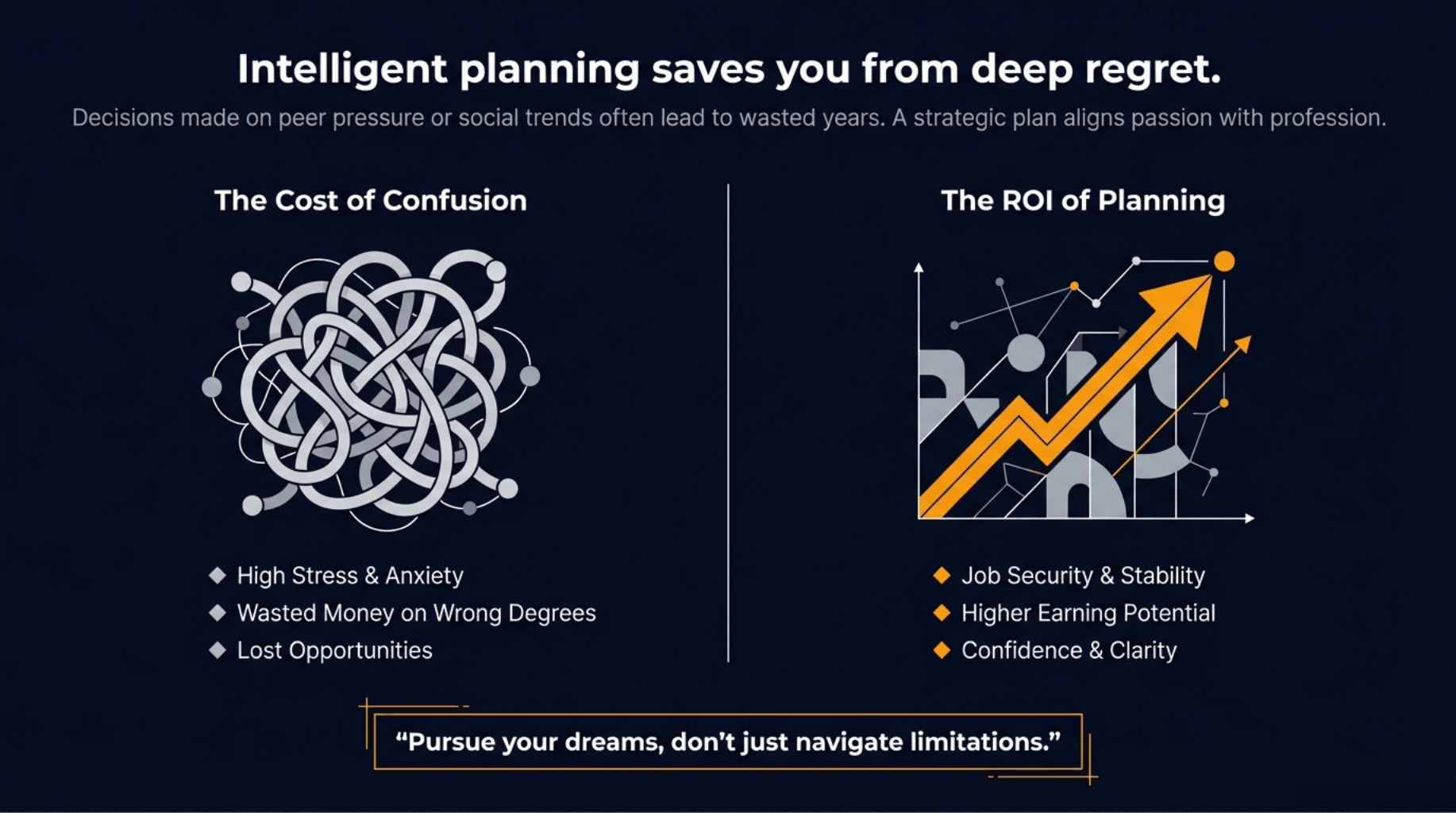
Generally, students choose courses because of peer pressure, social trends, or family expectations. However, intelligent career planning could save you from deep regret in the long run.
These are the reasons why your career after 12th needs to be planned:
- Matches Interests with Career: Enables you to align your hobbies and passions with your professional path
- Provides a Roadmap: Acts as a clear guide for your future career progression
- Saves Resources: Saves time and money by ensuring wise educational investments
- Enhances Job Security: Improves your employment stability and opens up new growth opportunities
- Reduces Stress: Lessens academic pressure and confusion during decision-making
- Increases Earning Potential: Boosts the possibility of higher future income
- Builds Confidence: Gives you clarity and helps you make decisions with assurance
As soon as you start thinking about your future and planning it, your academic life will become more about pursuing your dreams and less about navigating limitations.
Career Options After 12th Science
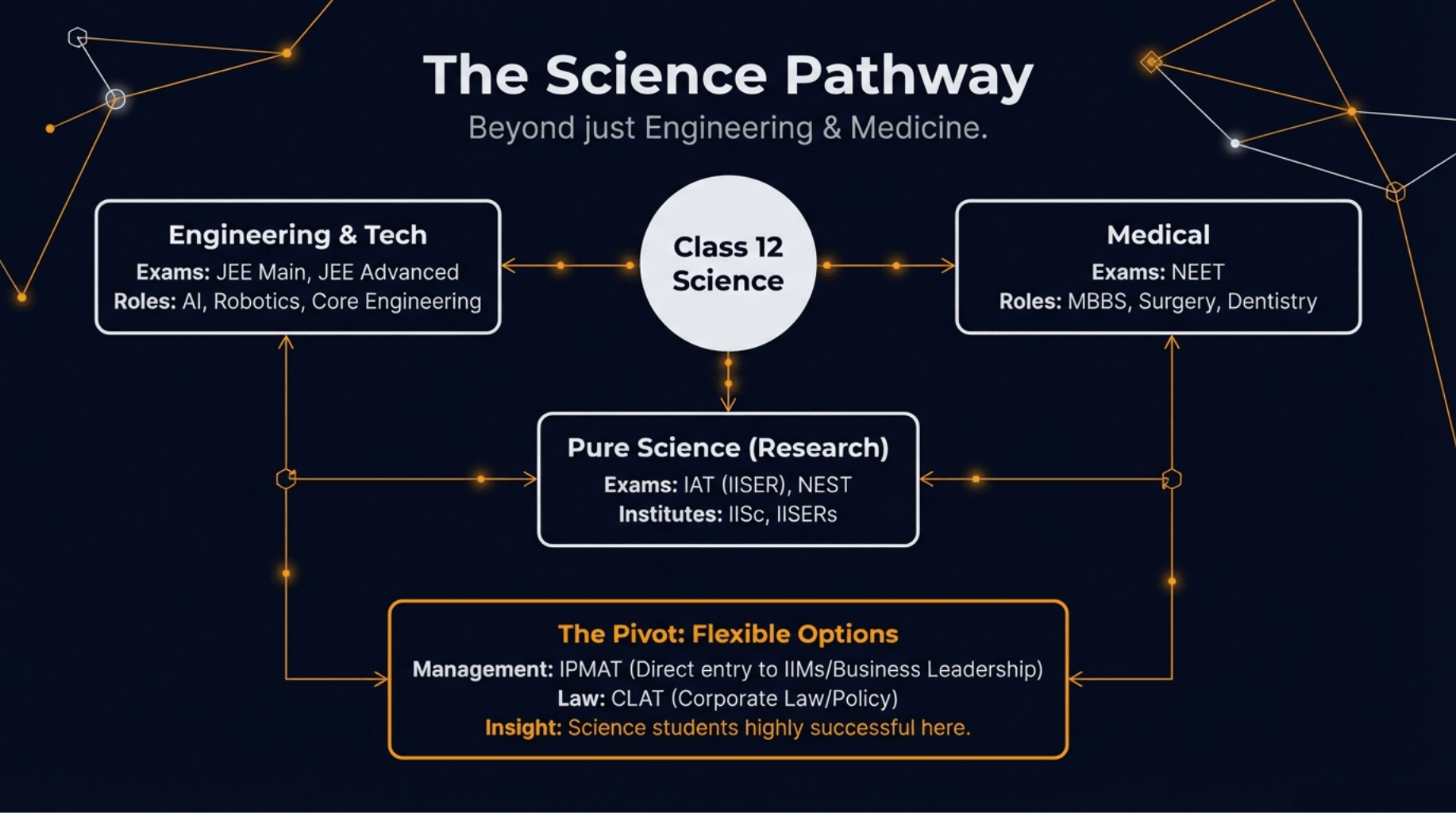
After completing 12th in the Science stream, students with different interests have diversified career options available to them.
Engineering & Technology
The engineering path through JEE Main & JEE Advanced for B.Tech/M.Tech programs remains one of the most popular choices. Students can specialize in various branches like Computer Science, Mechanical, Civil, Electrical, or emerging fields like Artificial Intelligence and Robotics. JEE Main 2026
Medical & Healthcare
The medical field through NEET for MBBS and related courses offers a noble and rewarding career path. Options include medicine, surgery, dentistry, nursing, pharmacy, and alternative medicine systems.
Pure Science & Research
IAT (IISER Aptitude Test)- For those inclined toward research and academia, pure science programs at top institutes like IISc and IISERs offer excellent opportunities in physics, chemistry, mathematics, biology, and environmental sciences.
Management (IPM)
Science students with business acumen can opt for IPMAT, which provides direct entry into IIMs through the 5-year Integrated Program in Management (IPM), paving the way for a career in business leadership.
Law (CLAT)
Science students with an interest in law may take the CLAT exam to gain entry into NLUs and top law colleges for 5-year integrated LLB programs (BA/BSc/BBA LLB). Law graduates can explore options like corporate law, litigation, legal advisory, judiciary, or policy roles. About CLAT Exam
Emerging Technology Fields
New-age fields such as Data Science, Artificial Intelligence, Biotechnology, and Space Science present global career opportunities with high growth potential and innovation scope.
| Career Path | Entrance Exam | Courses | Key Specializations / Fields | Top Institutes / Opportunities | Career Scope |
|---|---|---|---|---|---|
| Engineering & Technology | JEE Main, JEE Advanced, State Exams | B.Tech, BE, Integrated M.Tech, Diploma | CSE, AI, Mechanical, Civil, Electrical, Electronics | IITs, NITs, IIITs, Top Private Universities | Software Engineer, Core Engineer, Tech Lead, R&D Specialist |
| Medical & Healthcare | NEET | MBBS, BDS, BAMS, BHMS, Nursing, Pharmacy | Medicine, Surgery, Dentistry, Ayurveda, Nursing | AIIMS, Government & Private Medical Colleges | Doctor, Surgeon, Pharmacist, Healthcare Specialist |
| Pure Science & Research | IAT (IISER), NEST, Institute Tests | B.Sc, Integrated M.Sc, Research Programs | Physics, Chemistry, Maths, Biology, Environmental Science | IISc, IISERs, Central Universities | Scientist, Researcher, Professor, PhD Scholar |
| Management (IPM) | IPMAT (IIM Indore & Rohtak) | 5-Year IPM (BBA + MBA) | Business, Finance, Marketing, Strategy | IIMs | Manager, Consultant, Entrepreneur, Corporate Leader |
| Law (CLAT) | CLAT | Integrated LLB (BA/BSc/BBA LLB) | Corporate Law, Criminal Law, Civil Law, IPR | NLUs, Top Law Colleges | Lawyer, Legal Advisor, Judge, Policy Expert |
| Emerging Technology Fields | University/Institute Exams | Specialized UG/PG Programs | Data Science, AI, Robotics, Biotechnology, Space Science | IITs, Global Universities, Research Labs | Data Scientist, AI Engineer, Research Scientist, Biotechnologist |
Important Syllabus & Exam Resources
JEE Main Syllabus-Complete subject-wise breakdown IAT Syllabus-Science aptitude test pattern NEET Syllabus-Physics, Chemistry, Biology topics IPMAT Syllabus-Quantitative, Verbal, Logical sections CLAT Syllabus-Legal reasoning, GK, English, etc.
Career Options After 12th Commerce
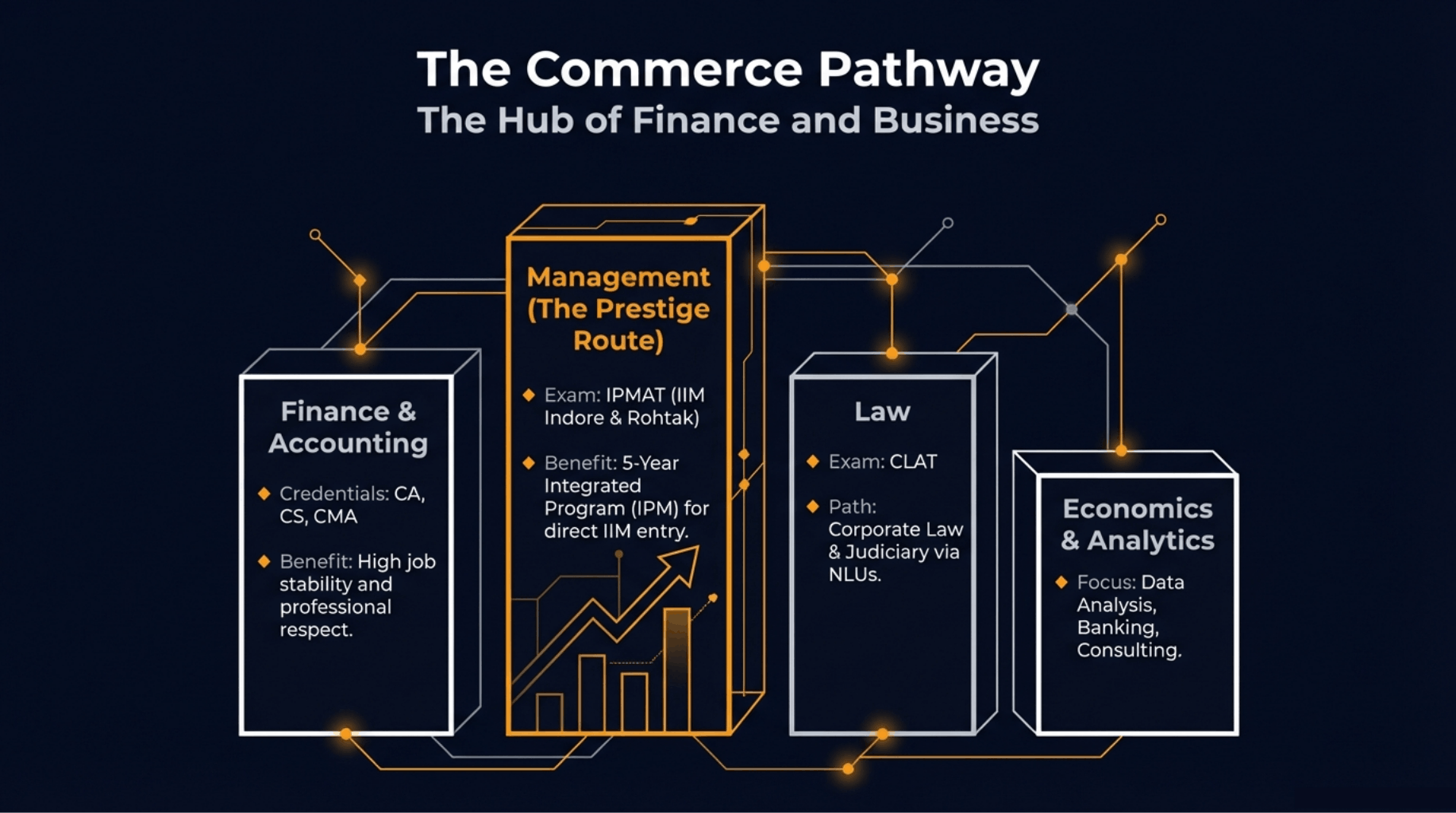
Students completing 12th Commerce have numerous excellent career opportunities in fields such as management, finance, analytics, and law.
Management & Business
Commerce students aiming for management careers can pursue BBA, BMS or the prestigious IPMAT route for direct entry into IIMs through the 5-year IPM program.
Finance & Accounting
For those passionate about numbers and finance, pursuing professional courses like CA, CS, CMA, or academic degrees like B.Com, BAF, and BFM leads to secure and respected careers.
Economics & Analytics
Students interested in economic trends and data can explore Economics and Analytics domains, leading to careers in banking, consulting, research, and data analysis.
Law (Through CLAT)
Commerce students with an aptitude for law can take CLAT for entry into NLUs, pursuing integrated law programs that combine commerce and legal education for careers in corporate law and judiciary.
| Career Path | Popular Courses / Programs | Entrance Exam / Route | Key Benefits & Career Scope |
|---|---|---|---|
| Management & Business | BBA, BMS, Integrated MBA | IPMAT (IIM Indore & Rohtak) | Direct entry to IIMs, leadership & management careers, entrepreneurial opportunities |
| Finance & Accounting | CA, CS, CMA, B.Com, BAF, BFM | Professional Exams / University Admissions | High job stability, strong income potential, professional respect, global opportunities |
| Economics & Analytics | BA/BSc Economics, Business Analytics, Statistics | University Admissions | Careers in banking, financial consulting, economic research, and data analytics |
| Law (Through CLAT) | BA LLB, BBA LLB, BCom LLB, LLM | CLAT | Entry to NLUs, careers in corporate law, judiciary, advocacy, legal consultancy |
Career Options After 12th Arts/Humanities
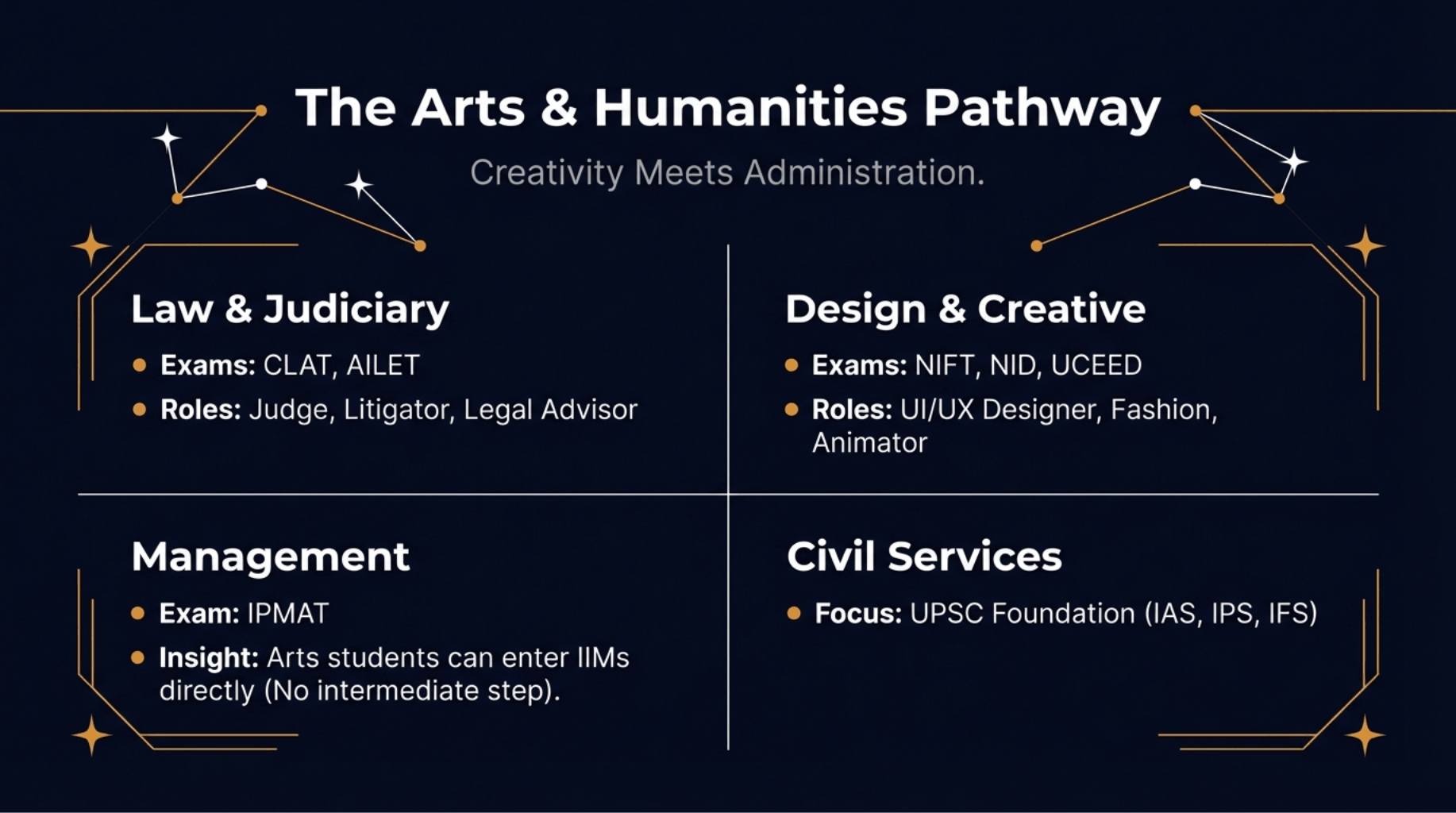
Students completing 12th Arts/Humanities can choose from diverse career options including Law, Design, Media, Management, and Civil Services.
Law
Arts students can become lawyers, judges, or legal advisors by studying law through various courses available after clearing exams like CLAT and AILET.
Design & Creative Fields
Aspiring designers can secure admission to premier design institutes like NIFT, NID, and through UCEED for various creative and design careers.
Media & Communication
Media and communication courses in journalism, digital marketing, public relations, and mass communication help students become content creators, journalists, and media professionals.
Management (IPM)
Arts students can enter management through IPMAT, which provides a direct route to IIMs without any intermediate step via the 5-year IPM program.
Civil Services
Many Arts students opt for UPSC and State Services Exams for prestigious government positions like IAS, IPS, IFS, and other administrative roles.
| Career Path | Entrance Exam / Route | Courses | Career Opportunities |
|---|---|---|---|
| Law | CLAT, AILET | BA LLB, BBA LLB | Lawyer, Judge, Legal Advisor, Corporate Consultant, Legal Researcher |
| Design & Creative Fields | NIFT, NID, UCEED | Design & Creative Programs | Fashion Designer, UI/UX Designer, Animator, Product Designer, Graphic Artist |
| Media & Communication | University Admissions | Journalism, Mass Communication, PR, Digital Marketing | Journalist, Content Creator, Media Manager, PR Executive, Digital Marketer |
| Management (IPM) | IPMAT (IIM Indore & Rohtak) | 5-Year IPM (BBA + MBA) | Manager, Consultant, Entrepreneur, Corporate Leader, Business Strategist |
| Civil Services | UPSC / State PSC | Integrated / Self-Preparation Programs | IAS, IPS, IFS, State Administrative Officers, Government Policy Makers |
How to Choose the Right Course After 12th
Choosing the right career path requires careful self-assessment and practical considerations. Before making your decision, honestly answer these key questions:
Self-Assessment Questions:
- Which subjects do I enjoy and excel at naturally?
- What are my strengths, skills, and inherent talents?
- What kind of work environment motivates me?
- What are my long-term life and career goals?
Practical Considerations:
- What is the family budget for education?
- How reputable are the colleges offering my preferred course?
- What are the placement records and average salary packages?
- Is this profession likely to remain in demand for the long term?
- Do I have the determination and discipline to prepare for required entrance exams?
Making the Decision: The key to a successful career choice lies in balancing logical analysis with following your passion. A career chosen through reason and heart is more likely to bring both success and satisfaction.
Conclusion: Your Career After 12th Starts Today
There is no one-size-fits-all career pattern. Success comes from making informed decisions, working consistently, and receiving the right guidance. Whether you aim to be an engineer, doctor, lawyer, manager, designer, or researcher, planning your career after 12th with clarity is crucial.
Keep these principles in mind:
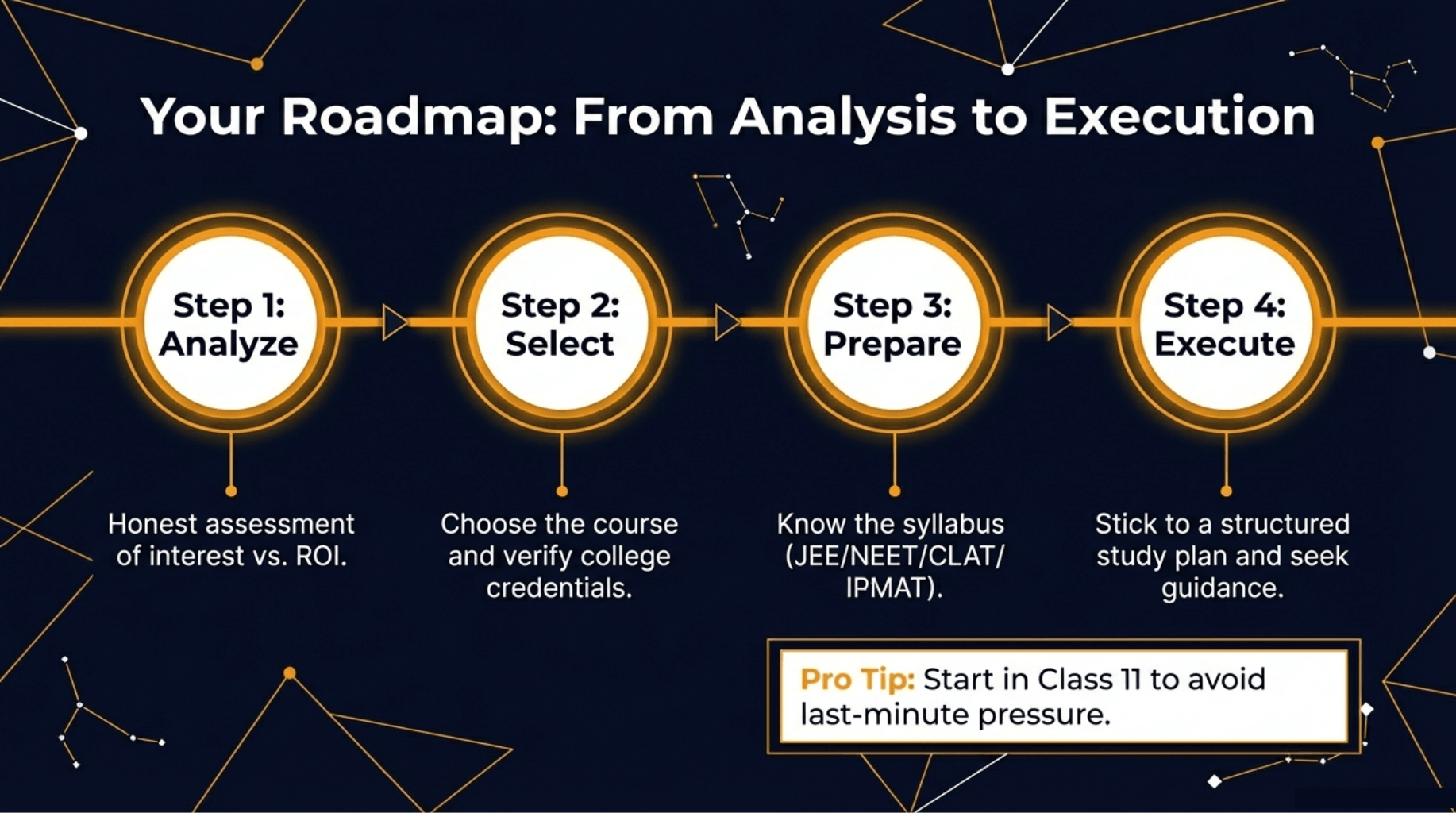
- Start with Passion: Choose a field that genuinely interests you
- Analyze ROI: Consider the return on investment of your chosen course
- Verify Credentials: Check the accreditation and reputation of colleges
- Plan Preparation: Develop a structured study plan for entrance exams
- Seek Guidance: Get support from career experts and mentors
Your future deserves meticulous planning. Remember, the career decisions you make today will shape your professional life for years to come.
Need Personalized Guidance? If you need tailored career counseling, college shortlisting assistance, or entrance exam preparation support, Edu Next is here to accompany you through every phase of your journey.
Frequently Asked Questions (FAQs)
Q1. Which is the best course after 12th?
The best course varies for each student and depends on your interests, aptitudes, and career goals. There's no universal "best" course—only what's best for you.
Q2. Can I change my stream after 12th?
Yes, you can switch streams after 12th. Many courses like BBA, Law, and Design accept students from all streams. Some programs may require bridge courses or additional preparation.
Q3. Is IPMAT better than a regular BBA?
IPMAT provides direct entry to IIMs through their 5-year integrated program, making it more prestigious and structured than a regular BBA. However, both have their merits depending on your career goals.
Q4. Engineering or Medical: Which is better?
Both are excellent career paths with different demands and rewards. Engineering offers diverse specializations and corporate opportunities, while medicine provides direct service roles and high respect. Consider your aptitude and interests, and take career assessment tests if undecided.
Q5. Are private colleges worth the investment?
Private colleges can be worth it if they have excellent faculty, strong infrastructure, good placement records, and necessary accreditations. Research thoroughly before investing in private education.
Q6. Should I take a drop year for preparation?
A drop year can be beneficial if used productively for focused preparation, skill development, or exploring alternatives. However, it requires discipline and a clear plan—otherwise, it may lead to wasted time.
Q7. How early should I start career planning?
Ideally, start exploring options from Class 11. Early planning gives you more time for preparation, research, and making informed decisions without last-minute pressure.