
CUET UG 2026: exam dates, pattern, syllabus, eligibility, and everything else you need to know
Blog
Leave your details and our counselors will reach out to you shortly.
🎧 Listen to this article
CUET UG 2026: exam dates, pattern, syllabus, eligibility, and everything else you need to know
Quick summary
- CUET UG 2026 is scheduled between May 11–31, 2026 in CBT (computer-based test) mode. Registration closed March 11, 2026.
- Over 280 universities now accept CUET scores for UG admissions — including all central universities (DU, JNU, BHU, Jamia, AMU), many state universities, and select private institutions.
📌 Get access To: CUET Mini Mock Test
- The exam has 3 sections: Language (Section 1A/1B), Domain Subjects (Section 2 — choose up to 6), and General Test (Section 3).
- Scoring: +5 for correct, −1 for wrong, 0 for unattempted. Maximum = 200 per subject.
- 6 domain subjects have been discontinued for 2026: Entrepreneurship, Teaching Aptitude, Fashion Studies, Tourism, Legal Studies, and Engineering Graphics.
Introduction
If you are a Class 12 student planning to apply to any central university in India, CUET UG 2026 is not optional. Since 2022, every central university — including Delhi University, JNU, BHU, Jamia Millia Islamia, and Allahabad University — has moved to CUET for all undergraduate admissions. Board exam percentages no longer determine your college. Your CUET score does.
That is a big shift. And if you have been spending the last year preparing for boards without understanding how CUET works, this guide is your starting point.
We cover everything here — dates, registration, eligibility, exam pattern, section-wise syllabus, which universities accept CUET, how scores are used for admission, and how to prepare. No padded-out content, no outdated "44 central universities" myth. Just current, verified information.
1. What is CUET UG 2026?
CUET stands for Common University Entrance Test. It is conducted by the National Testing Agency (NTA) and serves as the single entrance exam for undergraduate admissions across all central universities and 280+ other participating institutions in India.
Before CUET (introduced in 2022), each university ran its own admission process — DU used board cut-offs, JNU had its own test, and so on. CUET standardised this into one common exam. A student now appears for CUET once and can use that score to apply to hundreds of universities.
Why CUET matters more than your board score:
Since 2022, board examination percentages are not used for central university UG admissions. This is not a proposal or a pilot — it is the current reality. A student with 85% in boards and a 750/800 in CUET will get admission over a student with 97% in boards and a 650/800 in CUET. Every time.
📌 Related Blog: CUET 2026 last 3 weeks
2. Important dates
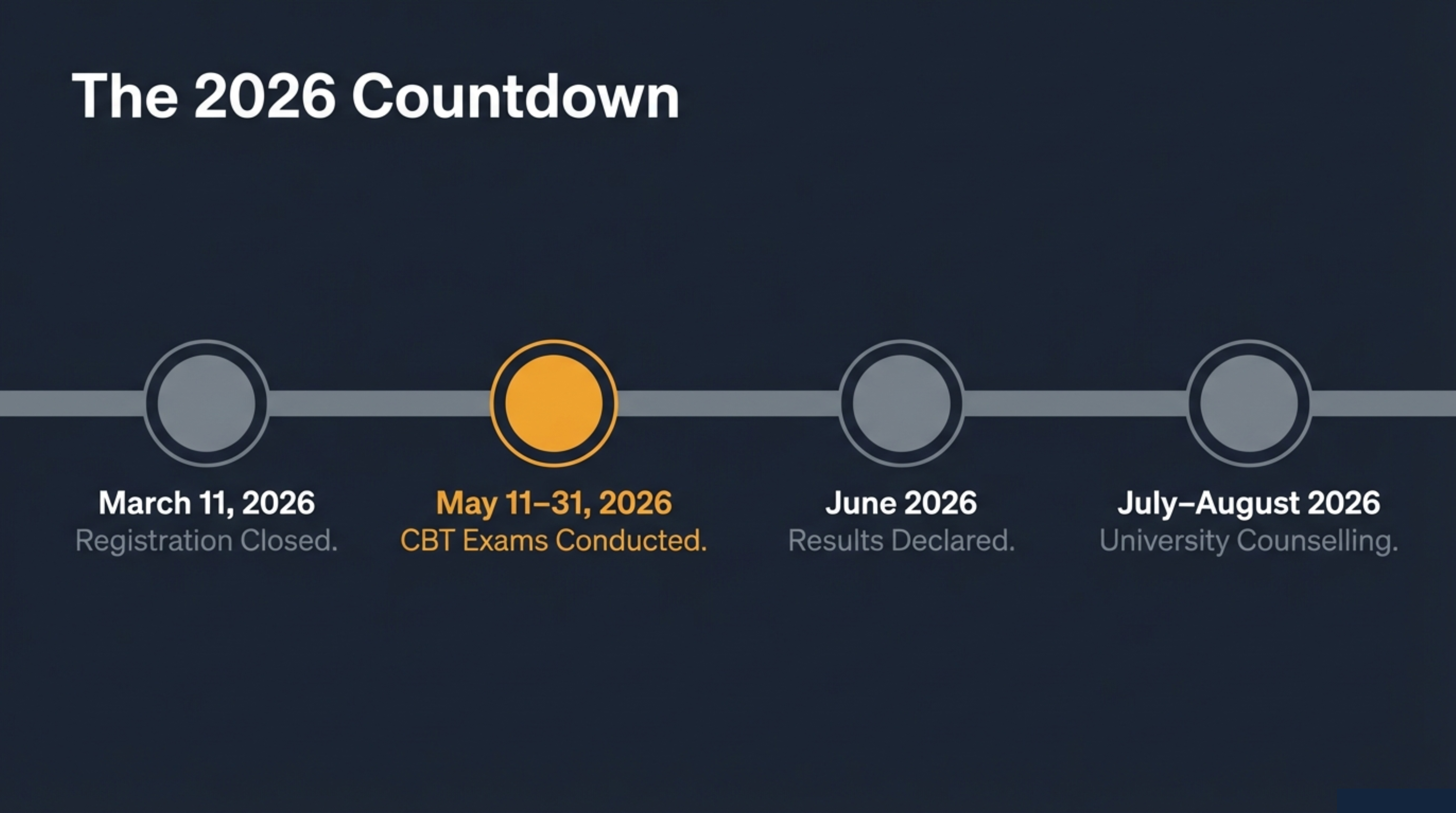
| Event | Date |
|---|---|
| CUET UG 2026 registration opens | January 2026 |
| Registration last date | March 11, 2026 |
| Application correction window | March 2026 (check NTA website) |
| Admit card release | To be announced — check cuet.nta.nic.in |
| CUET UG 2026 exam | May 11–31, 2026 (tentative) |
| Result declaration | June 2026 (expected) |
| University counselling / admission | July–August 2026 (university-wise) |
Important: Registration for CUET 2026 closed on March 11, 2026. If you missed it, you cannot appear for CUET 2026. Plan for CUET 2027 if so. All date information above should be verified at cuet.nta.nic.in as NTA may revise schedules.
3. Eligibility criteria
| Criterion | Requirement |
|---|---|
| Qualifying exam | Class 12 (or equivalent) from a recognised board |
| Minimum marks | No minimum percentage specified by NTA — individual universities set their own cutoffs |
| Age limit | No upper age limit for most programs (verify with specific university) |
| Appearing status | Students appearing in Class 12 in 2026 can also apply (provisional) |
| Number of attempts | No restriction on the number of times you can appear for CUET |
Category-specific notes:
| Category | Reservation (central universities) |
|---|---|
| SC | 15% seats |
| ST | 7.5% seats |
| OBC-NCL | 27% seats |
| EWS | 10% seats |
| PwD (horizontal) | 5% across all categories |
Reservation benefits apply at the university level during counselling, not in the CUET exam itself. Separate cutoffs exist for each category.
4. How to register for CUET 2026
(Registration for 2026 is closed. This section is a reference for CUET 2027 aspirants and for understanding the process.)
Step 1 — Create NTA account: Go to cuet.nta.nic.in and register with your email and mobile number.
Step 2 — Fill application form: Enter personal details, Class 12 details, and select your subjects and preferred exam cities.
Step 3 — Choose subjects carefully:
- Section 1A: Pick English or your language (most universities require English)
- Section 1B: Optional additional language
- Section 2: Domain subjects — pick only the ones required by your target universities and programs (maximum 6, from 29 available)
- Section 3: General Test — required by many universities for B.Com, BBA, and interdisciplinary programs
Step 4 — Pay application fee:
| Category | Fee |
|---|---|
| General / OBC-NCL / EWS | ₹650 (up to 3 subjects) |
| SC / ST / PwD / Third Gender | ₹600 (up to 3 subjects) |
| Additional subjects | ₹150 per subject (General), ₹100 (SC/ST/PwD) |
Step 5 — Download confirmation page and keep it safe.
Tip: Choose your domain subjects based on the programs you want to apply for — not based on what you studied in Class 12. Check each target university's subject requirements before filling the form.
5. Exam pattern
CUET UG 2026 is a computer-based test (CBT). All questions are MCQs (4 options, 1 correct answer).
| Section | Content | Total questions | Questions to attempt | Time |
|---|---|---|---|---|
| Section 1A | English Language | 50 | 40 | 45 min |
| Section 1B | Other Indian languages (13 options) | 50 | 40 | 45 min |
| Section 2 | Domain-specific subjects (up to 6 from 29) | 50 per subject | 40 per subject | 45 min per subject |
| Section 3 | General Test | 75 | 60 | 60 min |
Marking scheme:
| Attempt | Marks |
|---|---|
| Correct answer | +5 |
| Wrong answer | −1 |
| Unattempted | 0 |
Maximum marks per subject: 200 (40 questions × 5 marks)
Total possible score depends on how many subjects you attempt. If you sit for English + 2 domain subjects + General Test, your total would be 800.
Important changes for CUET 2026:
6 domain subjects have been discontinued and are no longer available: Entrepreneurship, Teaching Aptitude, Fashion Studies, Tourism, Legal Studies, and Engineering Graphics. If you registered for any of these in a previous year, do not assume they are available in 2026.
6. Section-wise syllabus
Section 1A & 1B — Languages
The language sections test reading and language comprehension, not literature or grammar in isolation.
| Topic area | What is tested |
|---|---|
| Reading comprehension | Unseen prose passages — main idea, inference, tone, vocabulary in context |
| Verbal ability | Sentence correction, error spotting, fill in the blanks |
| Rearrangement | Jumbled sentences and paragraphs |
| Literary text | Short prose or poetry excerpts with comprehension questions |
For Hindi (Section 1B), additional topics include: sandhi, samas, muhavare, alankar, and ras. For other languages, equivalent grammar topics apply.
Source: Based on NCERT Class 12 language textbooks + standard grammar concepts. Not syllabus-bound like domain subjects — practice reading and comprehension.
Section 2 — Domain subjects (29 available in 2026)
| Stream | Available domain subjects |
|---|---|
| Science | Physics, Chemistry, Biology, Mathematics, Computer Science, Agriculture |
| Commerce | Accountancy, Business Studies, Economics |
| Humanities | History, Political Science, Geography, Psychology, Sociology, Philosophy, Home Science |
| Languages (as domain) | Hindi, English, Sanskrit, Urdu, Tamil, Bengali, Kannada, Malayalam, Odia, Punjabi, Gujarati, Marathi, Telugu |
| Others | Environmental Science, Physical Education, Mass Media, Fine Arts |
Discontinued in 2026 (not available): Entrepreneurship, Teaching Aptitude, Fashion Studies, Tourism, Legal Studies, Engineering Graphics.
Syllabus basis: NCERT Class 12 textbooks for all domain subjects. Not Class 11. CUET domain papers are tightly based on NCERT — students who know their Class 12 NCERT inside out have a significant advantage.
📌 Also check on EduNext: All about CUET 2027
Section 3 — General Test
The General Test is not tied to any specific Class 12 subject. It is tested separately and required by many universities for programs like BBA, B.Com, B.Sc. (Hons) programs that are not subject-specific.
| Area | Approximate weightage |
|---|---|
| General Knowledge & Current Affairs | 30–35% |
| Quantitative Reasoning | 20–25% |
| Logical & Analytical Reasoning | 25–30% |
| General Mental Ability | 15–20% |
What to study:
- Current Affairs: national and international events from the past 12 months (May 2025–May 2026), government schemes, awards, appointments, sports
- Quantitative Reasoning: Class 10 maths — percentages, profit-loss, ratio, time-speed-distance, data interpretation
- Logical Reasoning: series, syllogisms, coding-decoding, blood relations, seating arrangement
- General Mental Ability: direction sense, puzzles, alphanumeric series
7. Which universities accept CUET 2026?
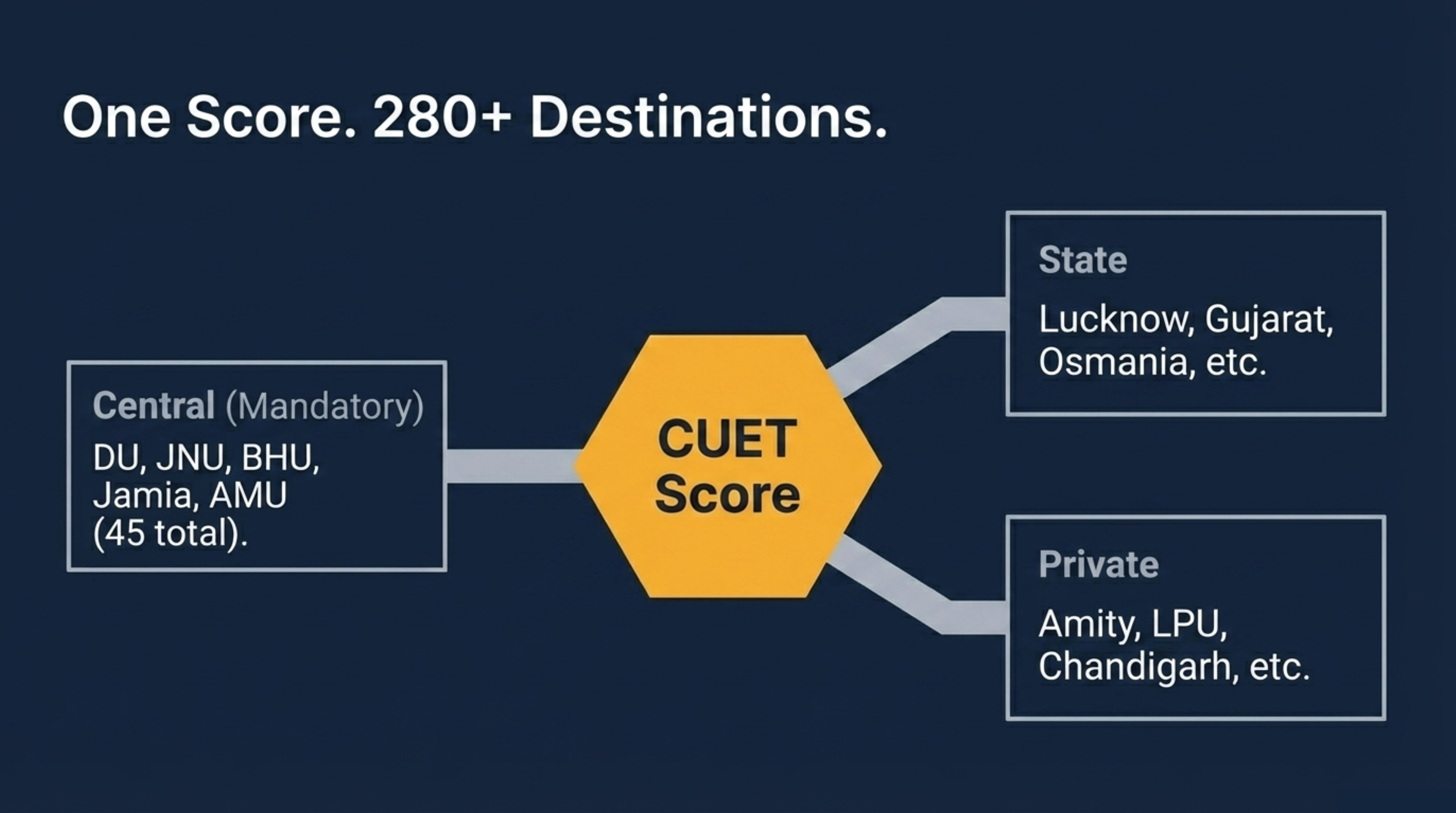
As of 2026, over 280 universities accept CUET UG scores. This is a major expansion from the original 44 central universities that piloted CUET in 2022. The number has grown every year.
Central universities (all mandatory)
| University | Location | Notable programs |
|---|---|---|
| Delhi University (DU) | Delhi | B.A., B.Com (Hons), B.Sc., B.Tech |
| Jawaharlal Nehru University (JNU) | Delhi | B.A. (Hons), integrated M.A./M.Sc. |
| Banaras Hindu University (BHU) | Varanasi | All UG programs across all faculties |
| Jamia Millia Islamia | Delhi | B.A., B.Com, B.Sc., B.Tech |
| Aligarh Muslim University (AMU) | Aligarh | B.A., B.Com, B.Sc. |
| Hyderabad University | Hyderabad | B.A., B.Sc., integrated programs |
| Pondicherry University | Puducherry | All UG programs |
| Allahabad University | Prayagraj | B.A., B.Sc., B.Com |
| North-Eastern Hill University | Shillong | B.A., B.Sc., B.Com |
(This is not exhaustive. All 45 central universities mandate CUET for UG admissions.)
State universities (select list)
Many state universities — including Lucknow University, Gujarat University, Osmania University, Vikram University, and Mahatma Gandhi Kashi Vidyapith — now accept CUET scores. The list expands annually.
Private universities (select list)
Several private universities including Amity, LPU, Chandigarh University, and others accept CUET alongside their own entrance tests or as a direct admission route.
8. How CUET scores are used for DU and other university admissions
Understanding this is critical because each university handles CUET scores differently.
Delhi University
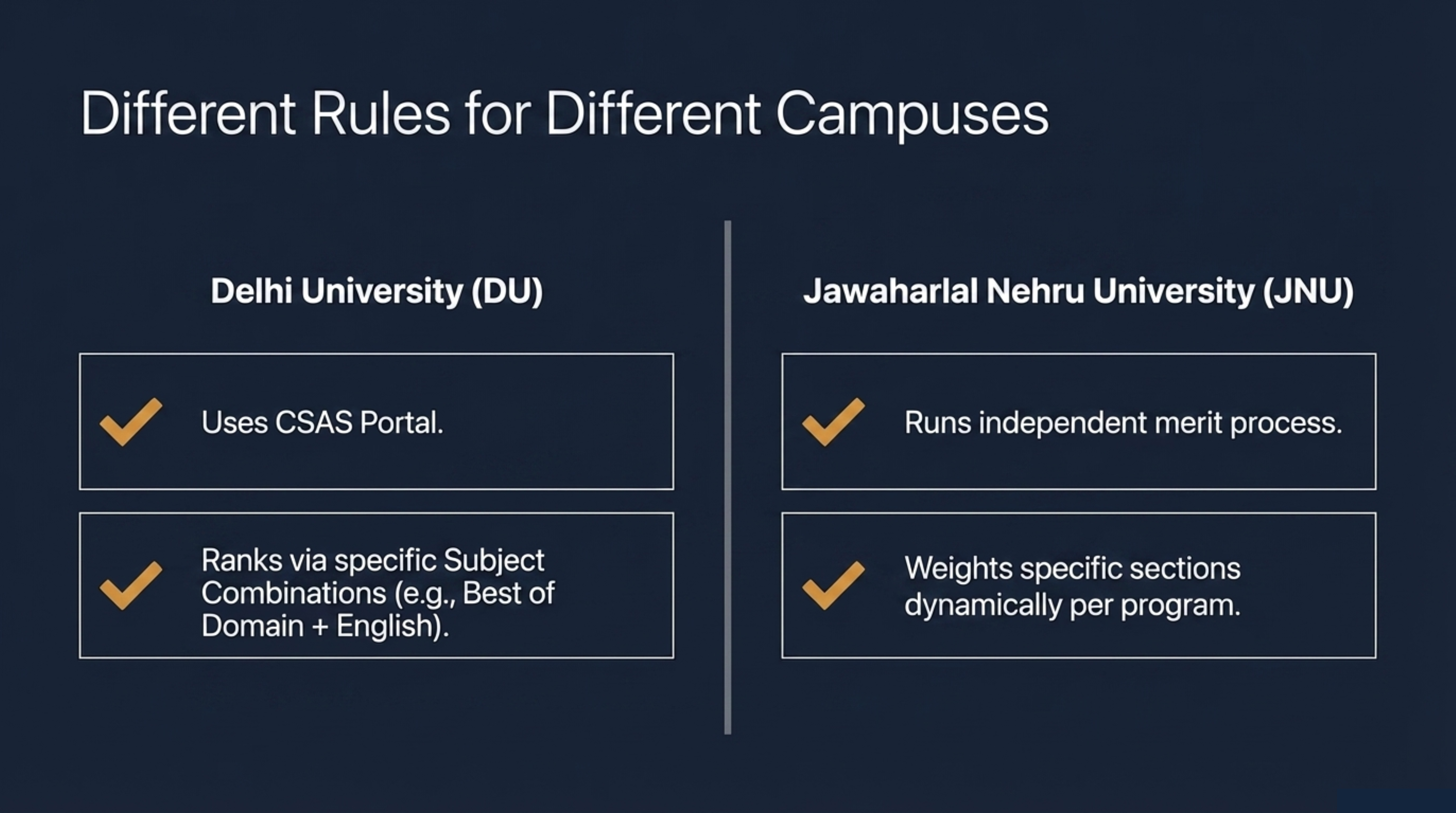
DU uses a Common Seat Allocation System (CSAS). After CUET results are declared, students register on the DU CSAS portal and fill their program-college preferences. DU calculates a "program-specific score" that may be based on one subject score, a combination of subjects, or the best score across relevant subjects depending on the program.
For example, for B.Com (Hons): DU uses the best score from Accountancy/Mathematics/Economics + English. For B.A. (Hons) History: it uses the History domain score + English.
No merit list based on boards. No interview. Only CUET score counts.
JNU
JNU runs its own merit process using CUET scores differently from DU. Each JNU program specifies which CUET sections are considered and how they are weighted. Check JNU's admission brochure on jnu.ac.in for program-specific details.
BHU
BHU uses CUET scores for most UG programs through a centralised counselling process. Seat allocation is based on CUET score + category.
Other universities
Each university publishes its own admission schedule and merit calculation method after CUET results. Always read the specific university's admission bulletin — do not rely on generic advice.
9. Preparation strategy: section-wise
Section 1A — English (30 days or less)
CUET English is reading-comprehension heavy. 3–4 unseen passages, vocabulary in context, sentence correction, and rearrangement. The fastest gains come from:
- Daily reading of editorials or non-fiction articles (20 min/day builds speed and comprehension)
- Revising 10–12 core grammar rules (subject-verb agreement, tense, parallelism)
- Timed practice — 45 minutes for 40 questions leaves about 67 seconds per question
Section 2 — Domain subjects
The single most important study strategy here is: use NCERT Class 12 textbooks, not coaching notes. CUET questions are written from NCERT. Students who chase coaching material or shortcut notes often miss straightforward NCERT-based questions.
Spend at least 3 full reads of each domain subject NCERT before attempting mocks. Then switch to timed practice.
| Subject type | Best approach |
|---|---|
| Theory-heavy (History, Polity, Sociology) | Read NCERT 3x → make summary notes → solve PYQs |
| Numerical (Economics, Accountancy, Maths) | Understand concepts → solve 15+ problems/topic → timed sectional tests |
| Mixed (Psychology, Geography) | NCERT reading + diagram/map work + PYQs |
Section 3 — General Test
Do not neglect this section if your target programs require it. Many students lose DU BBA or B.Com seats because they scored high in domain subjects but low in the General Test.
Dedicate 45–60 minutes daily to: current affairs reading + 20 reasoning questions + 10 quant problems. Consistency matters more than intensity here.
Overall mock test strategy
From 4 weeks before CUET: take 2 full sectional mocks per week (timed). From 2 weeks before: 1 full-length mock per week. Analyse every wrong answer — not just what was right, but why you got it wrong.
10. Frequently asked questions
Is CUET 2026 compulsory for DU admission?
Yes. Since 2022, Delhi University admits all UG students exclusively through CUET scores. Board exam percentages are not considered for DU admissions in any program. This applies to all 70+ DU colleges including SRCC, Hindu, St. Stephen's, Hansraj, Miranda House, and Lady Shri Ram.
Can I apply to private universities with a CUET score?
Yes, many private universities now accept CUET scores. Some use it as a direct admission criterion; others use it alongside their own entrance test or for scholarship consideration. Check the specific university's admission policy for 2026.
What is the CUET 2026 exam date?
CUET UG 2026 is tentatively scheduled for May 11–31, 2026. NTA may revise this — always check cuet.nta.nic.in for confirmed dates.
How many subjects should I register for in CUET?
Register only for subjects that are required by your target universities and programs. Adding extra subjects you have not prepared for can harm your overall score through negative marking. Most students need 3–4 subjects: English + 2 domain subjects + General Test (for commerce/management programs).
What is a good CUET score for DU's top colleges?
For SRCC B.Com (Hons), Hindu B.A. (Hons) Economics, or LSR B.A. (Hons) English, you typically need 190+ out of 200 in your domain subject and 185+ in English. For less competitive programs or colleges, 160–180 is often sufficient. Cutoffs vary by program, college, and category every year.
What happens if I get a bad score in one section?
Most universities consider only specific sections relevant to your program. A low General Test score does not hurt you if the program you are applying to does not require it. A low score in a domain subject you did not prepare for also does not affect other applications. Know which sections matter for your target programs before the exam.
Is there a negative marking in CUET 2026?
Yes. −1 for every wrong answer. This makes random guessing risky. If you can eliminate 2 of 4 options, attempting the question is statistically worth it. If you have no idea and cannot eliminate any option, leave it unattempted.
11. Final verdict
CUET UG 2026 is now the single most important exam for any Class 12 student targeting a central university seat in India. It does not matter if you scored 95% in boards — what matters is your CUET score on exam day.
The exam is largely NCERT-based, which is both good news (you have already studied the material) and a trap (students underestimate it because it "looks familiar" and then run out of time in the actual CBT).
Three things that matter most: knowing your NCERT cold, practicing under timed conditions, and understanding exactly which sections and subjects your target universities require before you sit for the exam.
Once your CUET score is in hand, the next step is figuring out which colleges you are actually eligible for — and which ones are worth applying to. Do not rely on generic rankings. Look at program-specific cutoffs, fee structures, and real student reviews.
Ready to map your CUET score to real college options?
Use EduNext's CUET free Resources CUET Preptribe at getedunext.com — covers all 280+ universities, shows program-specific cutoffs, fees, placements, and verified student reviews. No forms. No spam calls. Ambition से Admission तक.