Scholarships Every First-Year College Student Should Apply For in 2026
Blog
Leave your details and our counselors will reach out to you shortly.
Scholarships Every First-Year College Student Should Apply For in 2026
Key Takeaways
- The National Scholarship Portal (NSP) 2026-27 cycle opened June 1, 2026, with most undergraduate scholarship deadlines falling around October 31, 2026 — apply early, the portal gets congested closer to the date.
- Government schemes like the Central Sector Scheme and AICTE Pragati are merit-cum-means based and specifically target first-year UG students.
- Private scholarships from Reliance Foundation and Kotak Education Foundation offer some of the highest per-year amounts, often up to ₹2 lakh over the course.
- Category-specific scholarships (SC/ST/OBC, minority, girls-only, disability) exist alongside general merit scholarships — most students qualify for more than one.
- One-Time Registration (OTR) on NSP is mandatory before applying to any central or state government scheme.
The first year of college is when scholarship eligibility is often at its widest — many schemes are designed specifically for students just starting undergraduate study, based on Class 12 marks and family income, before your college performance even comes into play. Skip this window, and some of the highest-value scholarships simply won't be open to you again.
Yet every year, thousands of eligible students miss out — not because they don't qualify, but because they don't know a scheme exists, or they apply after the deadline has quietly passed. This guide brings together the government, private, and category-specific scholarships worth applying for in 2026, without the spam-call follow-ups other platforms are known for.
EduNext tip: Apply to every scheme you're eligible for, not just one. Scholarships rarely disqualify you for holding multiple awards unless explicitly stated — stacking a government scheme with a private one is common and legal.
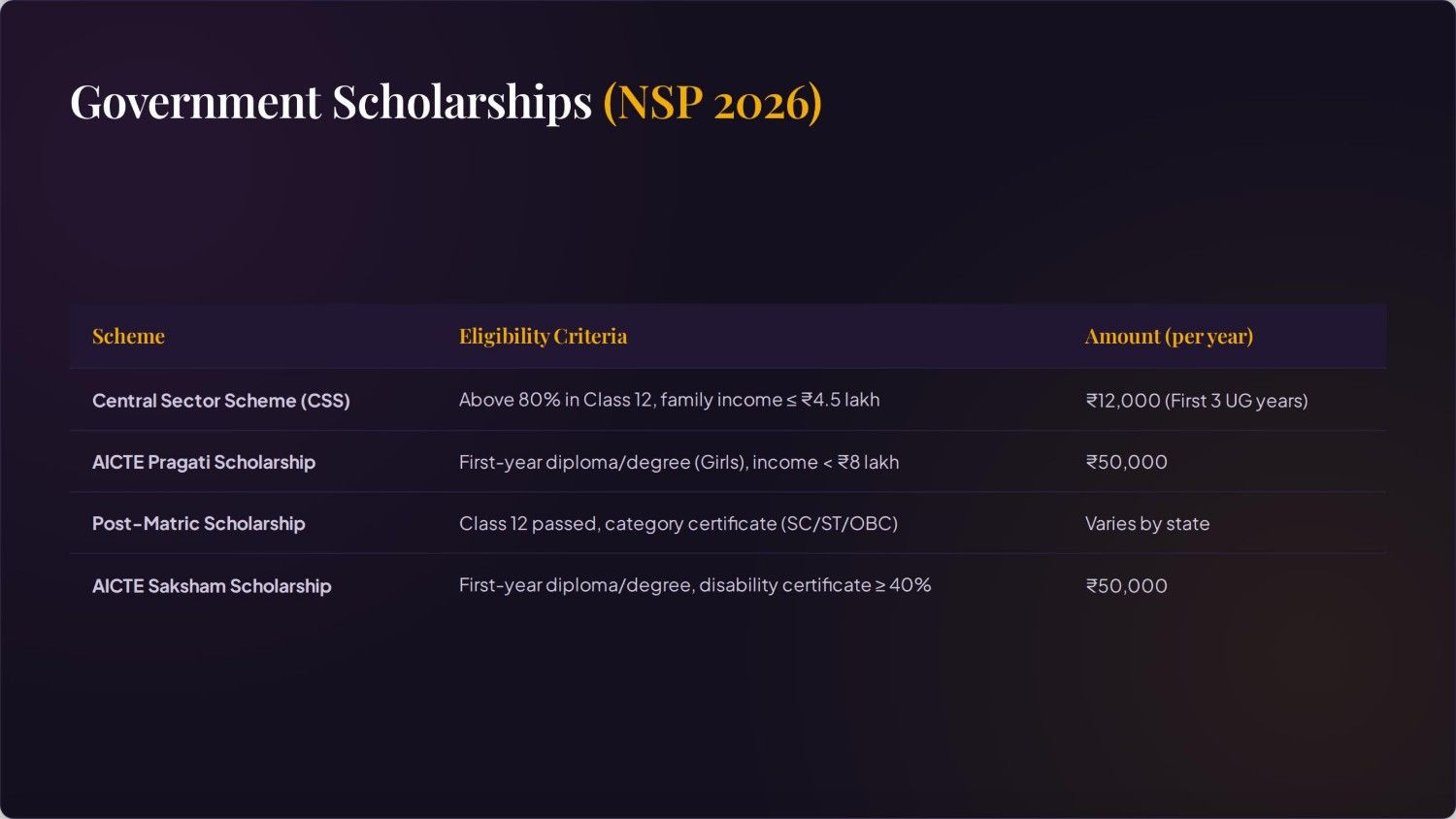
Central and state government schemes remain the largest source of undergraduate scholarship funding in India, and nearly all of them route through the National Scholarship Portal.
| Scheme | Eligibility | Amount (per year) |
|---|---|---|
| Central Sector Scheme (CSS) | Above 80% in Class 12, family income ≤ ₹4.5 lakh | ₹12,000 (first three UG years) |
| AICTE Pragati Scholarship (for girls) | First-year diploma/degree in AICTE-approved college, family income < ₹8 lakh | ₹50,000 |
| Post-Matric Scholarship (SC/ST/OBC) | Class 12 passed, category certificate, income criteria per state | Varies by state |
| AICTE Saksham Scholarship (for PwD students) | First-year diploma/degree, disability certificate ≥ 40% | ₹50,000 |
The NSP 2026-27 cycle opened on June 1, 2026, and the last date to apply for most undergraduate scholarships is October 31, 2026. Before applying to any scheme, you'll need to complete One-Time Registration (OTR) on scholarships.gov.in — do this early, since the portal slows down considerably as the deadline approaches.
Compare colleges before you finalise your admission on EduNext
Private scholarships often move faster than government ones and can be combined with them, so it's worth applying regardless of what you receive elsewhere.
| Scholarship | Eligibility | Amount |
|---|---|---|
| Reliance Foundation Undergraduate Scholarship | First-year UG (any stream), household income < ₹15 lakh | Up to ₹2 lakh over the degree |
| Kotak Kanya Scholarship | Girl students, professional UG courses, min. 85% in Class 12, income < ₹6 lakh | Up to ₹1.5 lakh per year, renewable |
| Aditya Birla Scholarship | Merit-based, top-ranked engineering/management/law students | Up to ₹1.75 lakh per year |
| HDFC Educational Crisis Scholarship | Family income disruption due to unforeseen crisis | Up to ₹75,000 per year |
Most of these run their own application cycles independent of NSP, so track each foundation's website directly rather than assuming a single portal covers everything.
Beyond general merit scholarships, several schemes exist for specific student groups — and many first-year students qualify for more than they realise:
- Minority community scholarships — for Muslim, Christian, Sikh, Buddhist, Parsi and Jain students, routed through NSP under the Ministry of Minority Affairs.
- SC/ST/OBC Post-Matric scholarships — state-administered, covering tuition and maintenance costs, with eligibility varying by state income ceilings.
- Girls-only scholarships — including AICTE Pragati and Kotak Kanya, designed to close gender gaps in technical and professional education.
- Disability scholarships — such as AICTE Saksham, for students with a certified disability of 40% or more.
- First-generation learner scholarships — offered by several state governments and private foundations for students whose parents did not complete higher education.
Don't self-select out: Reserved-category and need-based scholarships exist precisely because eligibility criteria are inclusive by design. If you're unsure whether you qualify, apply — the worst outcome is rejection, not penalty.
- Complete OTR on NSP first. This is the single mandatory step before any central or state scheme application.
- List every scholarship you may qualify for — merit, income, category and course-specific — rather than applying to just one.
- Keep documents scanned and ready: Class 12 marksheet, income certificate, category certificate (if applicable), Aadhaar, and bank account details linked to Aadhaar for direct benefit transfer.
- Track private foundation deadlines separately — they don't follow the NSP calendar and often close earlier than government schemes.
- Apply well before the deadline, not on the last date — portal congestion in the final days causes genuine, avoidable rejections.
Can I apply for more than one scholarship in 2026?
Yes, in most cases. Government and private scholarships can usually be held together unless a specific scheme states otherwise — always check the terms of each award.
What is the last date for NSP scholarships in 2026?
The NSP 2026-27 portal opened June 1, 2026, and most undergraduate scheme deadlines fall around October 31, 2026 — but always verify the exact date for your specific scheme on scholarships.gov.in.
Do I need to register separately for each scholarship?
For central and state government schemes, One-Time Registration (OTR) on NSP covers you across schemes. Private foundation scholarships require separate applications on their own websites.
Are scholarships only for students who scored above 90%?
No. While many merit scholarships set high cutoffs, several schemes are income-based, category-based, or gender-based rather than purely merit-based — first-generation learners and reserved-category students often qualify regardless of marks.
What documents do I need ready before applying?
Typically: Class 12 marksheet, income certificate, category certificate (if applicable), Aadhaar card, and a bank account linked to Aadhaar for scholarship disbursal.
Conclusion
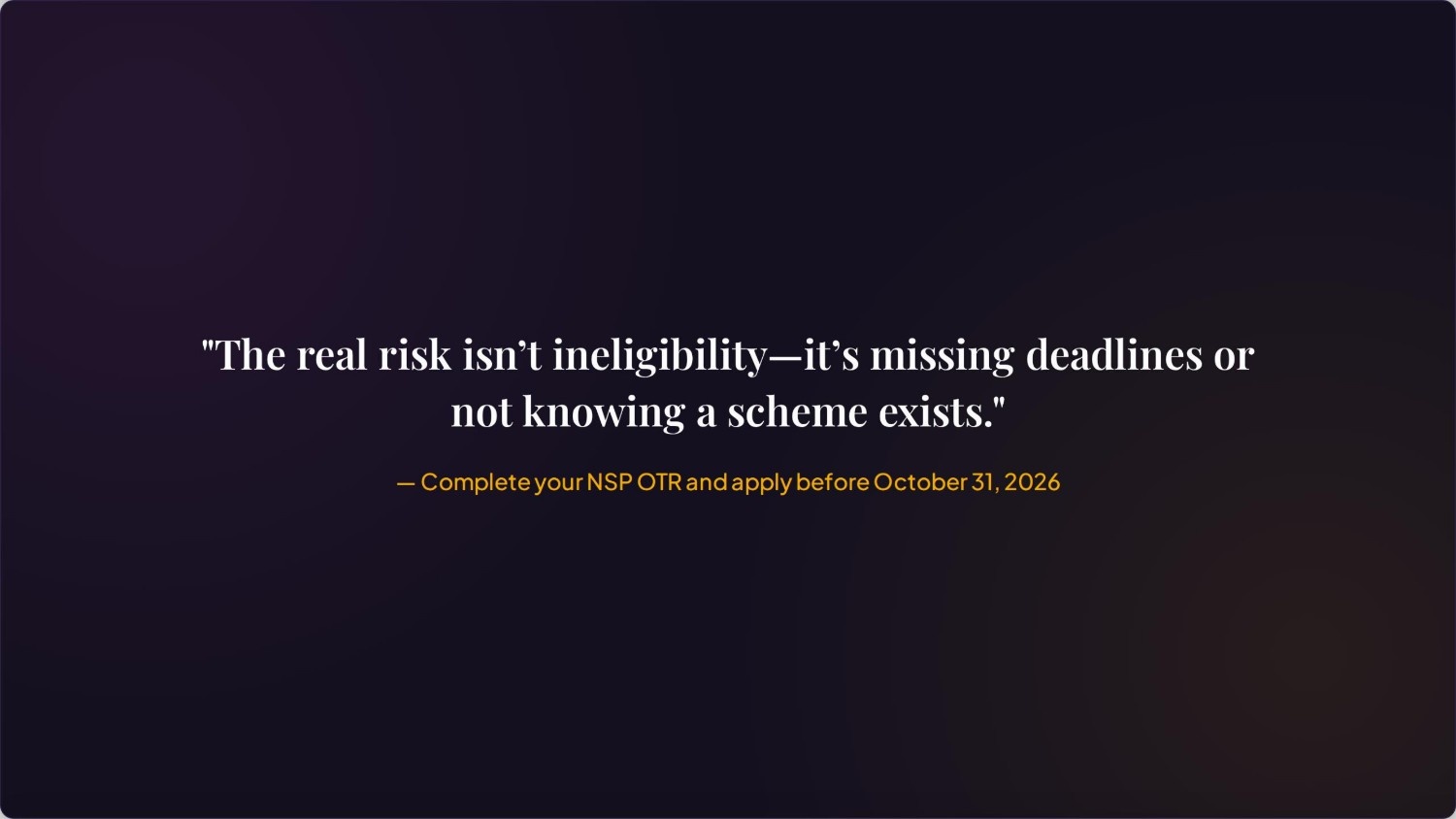
Scholarship eligibility is at its widest in your first year of college, and the schemes available in 2026 span government, private and category-specific options that most students can combine rather than choose between. The real risk isn't ineligibility — it's missing deadlines or not knowing a scheme exists. Complete your NSP OTR early, list out every scholarship you may qualify for, and apply well before October 31, 2026.
Still shortlisting colleges? Compare fees, scholarships and verified reviews across 10,000+ institutions on EduNext — zero spam calls, guaranteed → getedunext.com
Data current as of July 2026. Scholarship amounts, eligibility and deadlines change year to year — verify details on scholarships.gov.in and each foundation's official website before applying.