
CUET 2026 last 3 weeks: subject-wise strategy to score 750+
Blog
Leave your details and our counselors will reach out to you shortly.
🎧 Listen to this article
CUET 2026 last 3 weeks: subject-wise strategy to score 750+
Quick summary
- CUET UG 2026 is expected between May 11-31, 2026 (CBT mode). That gives you roughly 3 weeks from now.
- Over 280 universities accept CUET scores — this is not just a "DU exam" anymore. JNU, BHU, Jamia, Allahabad, and dozens of state universities use it for UG admissions.
- Scoring 750+ out of 800 is doable if you stop spreading yourself thin and focus on high-return topics in each section.
- This guide gives you a day-by-day, section-by-section plan. No motivational fluff. Just what to do, when, and why.

Introduction
Three weeks before CUET is the worst time to start something new. It is also, weirdly, the best time to gain 50-80 marks if you are strategic about it.
Most students at this stage fall into one of two traps. Either they panic-revise everything from scratch (and retain nothing), or they freeze up and just keep re-reading the same notes hoping something sticks. Both are bad strategies.
Here is what actually works with 21 days left: you identify the 20% of each subject that carries 80% of the marks, you drill those sections hard, you take timed sectional tests every other day, and you protect your sleep like it is worth marks (because it is).
This plan is built for students targeting 750+ across their CUET subjects. It assumes you have done at least basic preparation already. If you are starting from zero, this plan will still help, but adjust your target to 650-700 instead.
Also check on EduNext: All About CUET 2026 & 2027 — exam pattern, syllabus, important dates, and university-wise cutoff data. No forms, no spam calls.
Table of contents
- CUET 2026 exam structure: a 2-minute refresher
- The 21-day framework: how to split your time
- Section 1A: English language strategy
- Section 1B: other language strategy
- Section 2: domain subject strategy (top 6 subjects)
- Section 3: General Test strategy
- Day-by-day revision timetable (21 days)
- Common mistakes to avoid in the last 3 weeks
- Frequently asked questions
- Final verdict
1. CUET 2026 exam structure: a 2-minute refresher
Before we plan, let us make sure we are on the same page about what the exam looks like.
| Section | What it covers | Questions | Duration |
|---|---|---|---|
| Section 1A | English Language (compulsory for most universities) | 50 questions, attempt 40 | 45 minutes |
| Section 1B | Other language (Hindi, Tamil, Bengali, etc. — 12 options) | 50 questions, attempt 40 | 45 minutes |
| Section 2 | Domain subjects (you pick up to 6 from 29 subjects) | 50 questions per subject, attempt 40 | 45 minutes per subject |
| Section 3 | General Test (GK, reasoning, quant, current affairs) | 75 questions, attempt 60 | 60 minutes |
Scoring: +5 for correct, -1 for wrong, 0 for unattempted. Maximum per subject = 200. The 750+ target means you need an average of 187-190+ per subject across 4 subjects (if applying to DU or top central universities).
Important for 2026: NTA has discontinued 6 domain subjects — Entrepreneurship, Teaching Aptitude, Fashion Studies, Tourism, Legal Studies, and Engineering Graphics. If you were planning on any of these, they are no longer available. Check the official NTA bulletin at cuet.nta.nic.in.
2. The 21-day framework: how to split your time
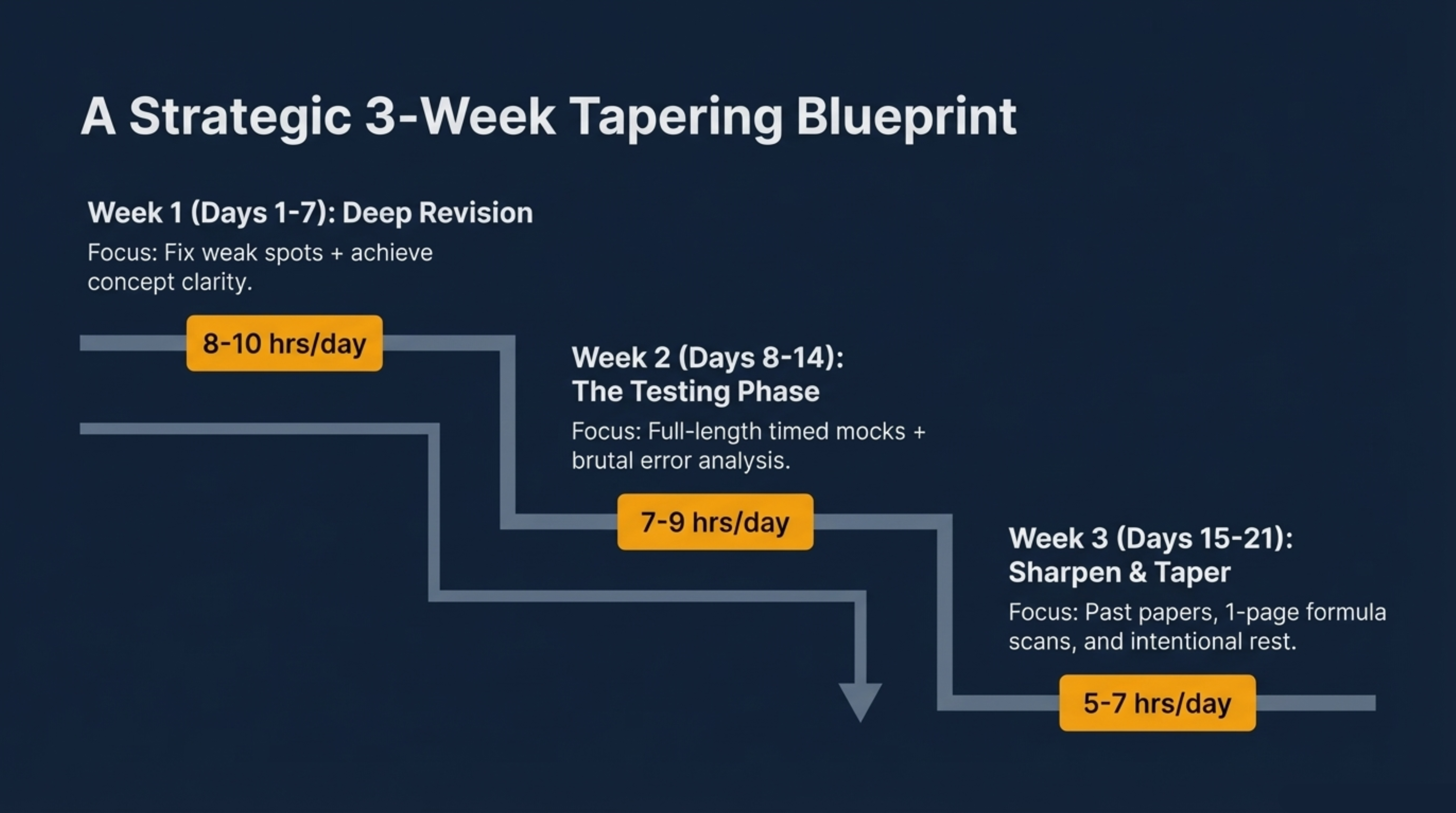
With 21 days left, you cannot give equal time to everything. Here is how to divide your 3 weeks:
| Week | Focus | Daily hours target |
|---|---|---|
| Week 1 (Days 1-7) | Deep revision of weak topics + concept clarity | 8-10 hours |
| Week 2 (Days 8-14) | Full-length practice tests + error analysis | 7-9 hours |
| Week 3 (Days 15-21) | Quick revision, past papers, mock tests, rest | 5-7 hours (taper down) |
Notice that Week 3 is deliberately lighter. This is not laziness. Cramming in the final 4-5 days leads to mental fatigue, which costs you more marks on exam day than one unrevised chapter ever could.
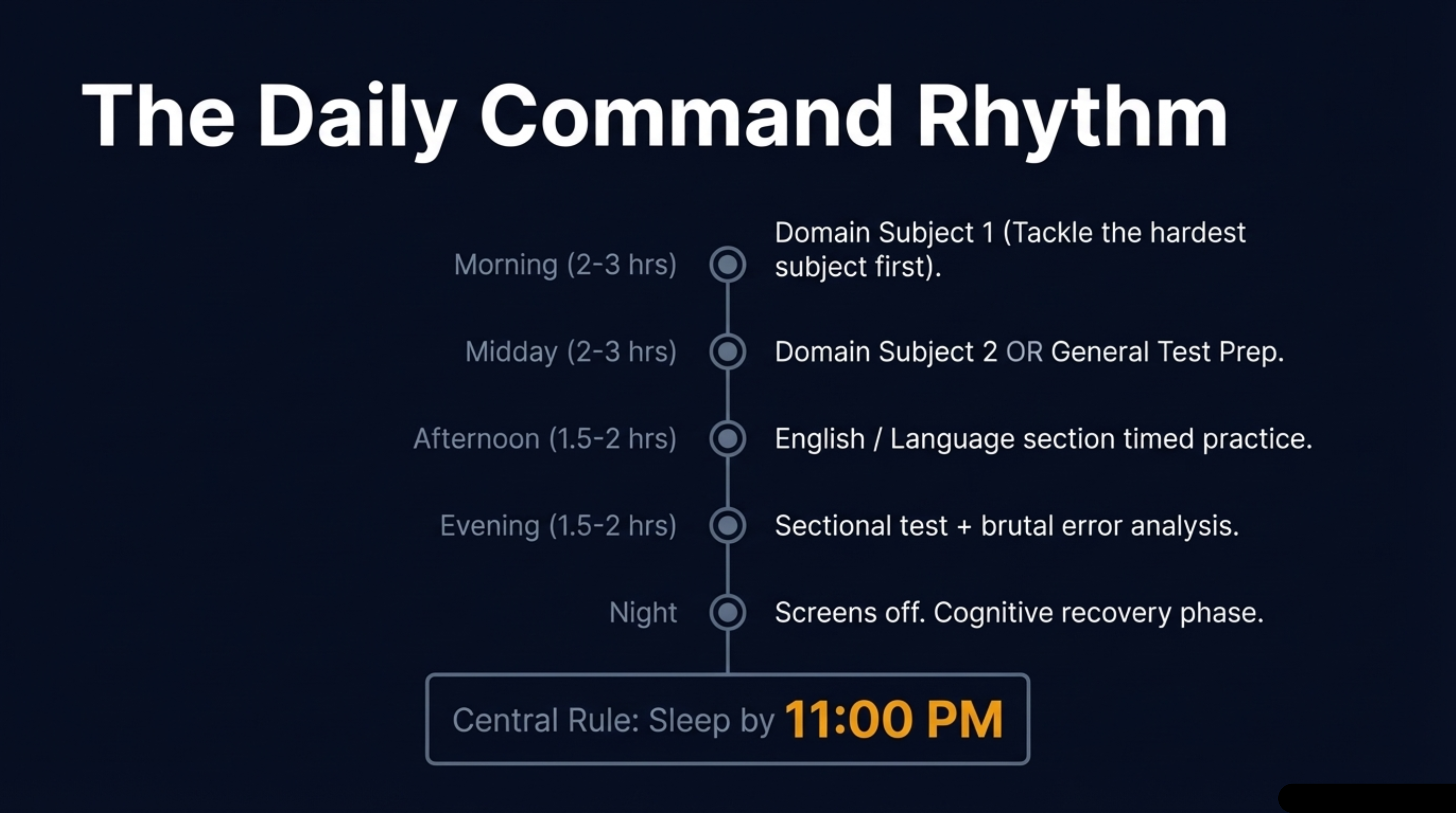
The daily split within each day should roughly look like this:
| Time block | Activity |
|---|---|
| Morning (2-3 hrs) | Domain subject revision (hardest subject first) |
| Midday (2-3 hrs) | Second domain subject or General Test prep |
| Afternoon (1.5-2 hrs) | English / Language section practice |
| Evening (1.5-2 hrs) | Sectional test + error analysis |
| Night | No studying. Sleep by 11 PM. Seriously. |
3. Section 1A: English language strategy
English is the easiest section to score 190+ in if you practice the right things. Most students lose marks here not because their English is weak, but because they mismanage time or overthink inference questions.
High-return topics (revise these first)
- Reading comprehension: You will get 3-4 passages. Practice skimming for main idea + scanning for specific details. Time yourself: 8-10 minutes per passage maximum.
- Vocabulary in context: Not isolated word meanings. CUET tests whether you understand the word as used in the passage. Practice this with previous year papers, not a word list.
- Error spotting and sentence correction: These are free marks if you know 10-12 grammar rules (subject-verb agreement, tense consistency, pronoun reference, parallelism, misplaced modifiers). Write these rules on a single page and revise daily.
- Rearrangement of sentences: Look for the opening sentence (usually introduces a topic without "this/that/these" references), then follow the logical flow.
What to skip or deprioritise
Idioms and phrases, literary terms, and obscure vocabulary. These appear rarely and unpredictably. Your time is better spent on RC accuracy.
Practice target for 21 days
Do 2 full English sections per week (timed, 45 minutes). Analyse every wrong answer. By exam day you should have done at least 6 full timed sections.
4. Section 1B: other language strategy
If you are appearing for Hindi, Tamil, Bengali, or any other language in Section 1B, the strategy is similar to English but with a few differences.
Most language papers test: unseen passages (prose and poetry), grammar (sandhi, samas, alankar for Hindi; equivalent for other languages), and basic literary knowledge.
For Hindi specifically: revise muhavare (idioms) and lokoktiyan (proverbs) — a set of 50-60 common ones covers what CUET typically asks. For grammar, focus on samas, sandhi, and ras. Poetry passages tend to come from well-known poets (Kabir, Tulsidas, Mahadevi Verma, Dinkar), so read a few stanzas from each to get comfortable with the style.
Do not spend more than 1 hour/day on this section. It is high-scoring but does not need the same deep revision as domain subjects.
5. Section 2: domain subject strategy (top 6 subjects)
This is where most marks are won or lost. Here is a targeted revision plan for the 6 most popular CUET domain subjects.
Economics
| Priority level | Topics | Why |
|---|---|---|
| Must revise | National Income, Money & Banking, Government Budget, Balance of Payments | These 4 chapters account for nearly 40-50% of questions |
| Should revise | Indian Economy (reforms since 1991, poverty, employment), Statistics (mean, median, mode, index numbers) | Moderate weightage, straightforward scoring |
| Low priority | Development Experience of India & neighbours, Rural Development | 2-3 questions max; not worth heavy time investment |
Tip: For numericals in Statistics and National Income, practice 10-15 problems daily. The formulas are few but you need speed.
Political Science
This is a reading-heavy subject. Do not try to memorise everything.
Focus areas: Indian Constitution (fundamental rights, DPSPs, federalism, amendments), important Supreme Court cases (Kesavananda Bharati, Minerva Mills, Maneka Gandhi), and India's foreign policy (NAM, India-China, India-Pakistan, nuclear policy). For contemporary politics, know the major events of 2024-2025 (elections, policy changes).
Skip: detailed chapter-by-chapter notes from Class 11. The exam skews towards Class 12 content and current affairs application.
History
Three time periods to prioritise: colonialism and nationalism (1857-1947), Mughal administration (Akbar to Aurangzeb), and ancient civilisations (Harappan, Mauryan). Each carries significant weightage.
Map-based and source-based questions have increased in CUET. Practice identifying locations, matching timelines, and interpreting primary source excerpts.
Psychology
Psychology is one of the highest-scoring CUET subjects if you approach it right. Focus on: intelligence and aptitude (theories + measurement), psychological disorders (DSM classification, types, symptoms), therapeutic approaches (CBT, psychoanalysis, humanistic), and human development (Piaget, Erikson, Kohlberg stages).
Make flashcards for key psychologists and their theories. This subject rewards recognition memory, so repeated reading of your notes works better than solving problems.
Accountancy
This is almost entirely numerical. If you can solve the problems, you score. If you cannot, reading theory will not save you.
Priority order: Partnership accounts (admission, retirement, dissolution), Company accounts (issue of shares and debentures), Cash Flow Statement, Financial Statement Analysis (ratios). Do 5 problems per topic per day. Speed matters more than anything else here.
Mathematics
CUET Maths is based on the NCERT Class 12 syllabus. It is not as hard as JEE, but it is not easy to finish in time if you are slow.
High-weightage chapters: Matrices and Determinants, Calculus (integration, application of derivatives), Probability, Linear Programming, and Relations and Functions. Practice NCERT examples and exercises first. If you have done those, you have covered 80% of what CUET asks.
6. Section 3: General Test strategy
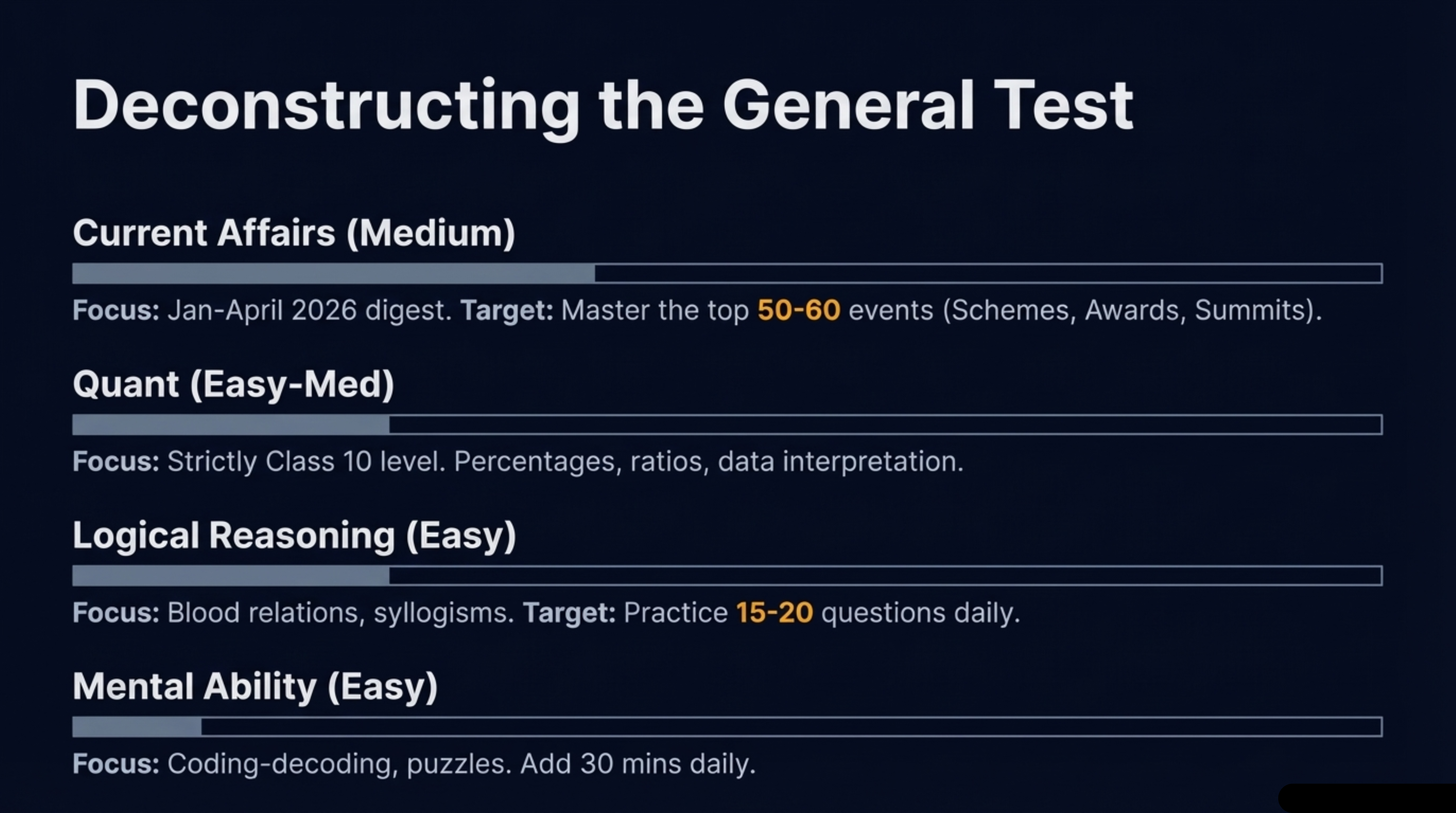
The General Test is required by many universities (especially for B.Com, BBA, and integrated programs). It covers four areas:
| Area | Approx. questions | Scoring difficulty |
|---|---|---|
| General Knowledge & Current Affairs | 20-25 | Medium (current affairs changes yearly, harder to prepare) |
| Quantitative Reasoning | 12-15 | Easy-Medium (basic Class 10 maths) |
| Logical Reasoning | 15-18 | Easy (pattern recognition, series, syllogisms) |
| General Mental Ability | 8-10 | Easy (puzzles, coding-decoding, direction sense) |
What to do in 21 days
Current Affairs: Read a monthly GK digest for January-April 2026. Focus on: government schemes, awards (Padma, Nobel, Booker), sports events, international summits, and appointments. Do not try to know everything. Know the top 50-60 events well.
Quantitative Reasoning: Revise percentages, profit-loss, ratio-proportion, averages, and basic data interpretation. These are Class 10 level. If you are from a Commerce or Science stream, this should take 2-3 days of revision maximum.
Logical Reasoning: Practice 15-20 questions daily from any standard reasoning book. Blood relations, seating arrangements, coding-decoding, number series, and syllogisms are the most frequent types.
General Mental Ability: This overlaps with reasoning. An extra 30 minutes daily on puzzles and analytical reasoning is enough.
7. Day-by-day revision timetable (21 days)
This timetable assumes you are taking 4 CUET sections: English, 2 domain subjects, and General Test. Adjust if you are taking more.
Week 1: deep revision
| Day | Morning (3 hrs) | Afternoon (3 hrs) | Evening (2 hrs) |
|---|---|---|---|
| Day 1 | Domain Subject 1 — weakest chapters | Domain Subject 2 — weakest chapters | English: 1 full timed section |
| Day 2 | Domain Subject 1 — numericals/practice | General Test: reasoning + quant revision | Current affairs (GK digest Jan-Feb 2026) |
| Day 3 | Domain Subject 2 — weakest chapters | Domain Subject 1 — moderate chapters | English: grammar rules revision + practice |
| Day 4 | Domain Subject 2 — numericals/practice | General Test: GK + mental ability | Sectional test: Domain Subject 1 |
| Day 5 | Domain Subject 1 — revise strong chapters quickly | Domain Subject 2 — moderate chapters | Analyse Day 4 sectional test errors |
| Day 6 | General Test: full timed practice | Domain Subject 1 — remaining gaps | Domain Subject 2 — remaining gaps |
| Day 7 | Light revision only. Read notes. No new topics. | Rest / light exercise | English: 1 full timed section |
Week 2: test and fix
| Day | Morning (3 hrs) | Afternoon (3 hrs) | Evening (2 hrs) |
|---|---|---|---|
| Day 8 | Full mock: Domain Subject 1 (timed) | Analyse mock + revise wrong topics | English practice |
| Day 9 | Full mock: Domain Subject 2 (timed) | Analyse mock + revise wrong topics | General Test practice |
| Day 10 | Revise error topics from Day 8-9 mocks | Current affairs (March 2026) | Sectional test: General Test |
| Day 11 | Full mock: English (timed) | Full mock: General Test (timed) | Analyse both mocks |
| Day 12 | Revise all flagged weak areas from Week 2 | Domain Subject 1 — previous year questions | Domain Subject 2 — previous year questions |
| Day 13 | Full-length mock (all 4 sections, back to back) | — continued — | Analyse full mock |
| Day 14 | Revise errors from Day 13 mock only. Nothing new. | Light reading of notes | Rest |
Week 3: sharpen and rest
| Day | Morning (2-3 hrs) | Afternoon (2 hrs) | Evening |
|---|---|---|---|
| Day 15 | Quick revision: Domain Subject 1 (formula sheet / key facts) | Quick revision: Domain Subject 2 | English: 1 timed section |
| Day 16 | General Test: final current affairs update (April 2026) | Light practice: reasoning + quant | Rest / walk / exercise |
| Day 17 | One last full mock (all sections) | Analyse it. Note final weak spots. | Done by 6 PM. |
| Day 18 | Revise only the weak spots from Day 17 mock | Read through your one-page formula/fact sheets | Rest. No new content. |
| Day 19 | Light revision: flip through notes | Organise exam documents (admit card, ID, stationery) | Relax. Watch something. |
| Day 20 | 30-minute quick scan of key formulas | Nothing. Rest. Eat well. | Sleep by 10 PM. |
| Day 21 (Exam Day) | Light breakfast. Reach centre 1 hour early. Trust your preparation. | — | — |
8. Common mistakes to avoid in the last 3 weeks
Starting a new topic you never touched. If you have not opened a chapter in 6 months, it is not going to stick in 3 weeks. Strengthen what you know instead of panicking about what you do not.
Solving only easy questions in practice. If your mocks feel comfortable, you are not practising at the right difficulty. Deliberately attempt questions that make you uncomfortable. That is where the improvement comes from.
Ignoring negative marking. At -1 per wrong answer, random guessing costs you. If you can eliminate 2 out of 4 options, attempt it. If you are fully guessing with no elimination, skip.
Sacrificing sleep for extra revision. A student who sleeps 7 hours and revises 8 hours will outperform a student who sleeps 4 hours and revises 12 hours. This is not opinion. This is how memory consolidation works. Your brain processes and stores information during deep sleep.
Not taking timed tests. Reading notes and solving untimed questions feels productive but does not prepare you for exam pressure. Every test you take should be timed, or it is just casual reading.
9. Frequently asked questions
What is a good CUET score for DU top colleges in 2026?
For top DU colleges like SRCC, Hindu, Hansraj, and LSR, you typically need 750+ out of 800 in your best 4 subjects. The exact cutoff varies by program and category. Since 2022, all DU admissions are through CUET scores only — board percentages are no longer used for admission.
How many subjects should I focus on in the last 3 weeks?
Focus on the subjects that matter for your target university and program. Most students need 3-4 subjects. Do not spread yourself across all 6 just because you registered for them. Pick your best 4 and go deep on those.
Can I score 750+ in CUET 2026 with only 3 weeks of preparation?
If you have been following Class 12 NCERT well and have decent fundamentals, yes. CUET is largely NCERT-based. Three focused weeks of revision and practice can push a 650-level student to 750+ if they follow a structured plan and take regular timed tests. If you are starting from scratch, target 650-700 instead and build from there.
Is CUET harder than board exams?
The content level is similar (both are NCERT-based), but CUET is trickier because it is MCQ-based with negative marking, and the time pressure is tighter. Board exams give you more time to think and write. CUET requires faster decision-making. Students who are good at boards but bad at MCQs often underperform in CUET, which is why timed practice is so important.
Which universities accept CUET 2026 scores?
Over 280 universities accept CUET UG scores as of 2026. This includes all central universities (DU, JNU, BHU, Jamia, Allahabad, Pondicherry, etc.), many state universities, and several private universities. The full list is on cuet.nta.nic.in. Do not rely on the old "44 central universities" figure — CUET participation has expanded massively since 2022. Explore all 280+ options on EduNext without filling a single form.
10. Final verdict
Three weeks is not a lot of time, but it is enough to make a real difference if you use it well. The students who score 750+ in CUET are not the ones who studied the most total hours. They are the ones who studied the right things, practised under timed conditions, analysed their mistakes honestly, and showed up on exam day well-rested.
Follow the weekly plan above, take your mocks seriously, and do not let anyone convince you that sleeping less means working harder.
Once you have your CUET score, the next step is figuring out which colleges you can actually get into — and which ones are worth going to. That is where EduNext comes in.