
CUET 2026 vs board marks: which matters more for DU, BHU & central university admissions?
Blog
Leave your details and our counselors will reach out to you shortly.
CUET 2026 vs board marks: which matters more for DU, BHU & central university admissions?
Since 2022, board marks play zero role in DU, JNU, BHU, Jamia, Allahabad University, and all other central university UG admissions. CUET score is everything.
A student with 75% in boards and 185/200 in CUET will beat a student with 97% in boards and 150/200 in CUET — every single time, for every program, at every central university.
Board marks still matter for: some private universities, BITS Pilani, school-level scholarships, and a handful of state universities that have not adopted CUET.
CUET UG 2026 is scheduled for May 11–31, 2026. Over 280 universities now accept CUET scores.

Introduction
For decades, getting into Delhi University meant one thing: board percentages. Some DU programs had cutoffs touching 100% — not as a joke, but as an actual admission reality. Students would lose seats over a single missed mark.That system ended in 2022.
The National Testing Agency introduced CUET — the Common University Entrance Test — and overnight, India's most competitive undergraduate admissions stopped being a board-percentage race. Four years later, many students and parents still do not fully understand what changed, what still matters, and where boards are still relevant. This post sets the record straight.
📌 Preparing for CUET 2026? PrepTribe by EduNext gives you daily challenges, video lessons, flashcards, and AI-powered tools built specifically for CUET, JEE & NEET aspirants. Free to start — no spam calls.
What changed in 2022 — and why it still confuses people
Before CUET, DU admission worked like this: CBSE releases board results in May, DU releases a series of merit lists based purely on Class 12 percentage, students with the highest marks get the top colleges. A student from a state board who scored 95% but was in a board known for grade inflation could get a DU seat over a student from a strict board who scored 93%. The system was both competitive and arbitrary.
In 2022, the Ministry of Education and UGC directed all 45 central universities to shift UG admissions entirely to CUET scores. Board percentages were discontinued as an admission criterion — not reduced, not made supplementary. Discontinued.
The confusion today happens because the shift was so complete that it feels hard to believe. Surely board marks count for something, parents ask. The answer, for central universities, is: not for admission. Your 95% does not get you a single extra mark in the CUET merit list. Your 65% does not disqualify you from anything, as long as you meet the minimum eligibility (Class 12 pass in the relevant subjects).
The exact rule: what boards decide vs. what CUET decides
| Admission factor | Board marks role | CUET score role |
|---|---|---|
| DU — all programs (2026) | Only eligibility (must have passed Class 12 in relevant subjects) | Determines admission rank entirely |
| JNU — UG programs | Only eligibility | Determines admission rank entirely |
| BHU — UG programs | Only eligibility | Determines admission rank entirely |
| Jamia Millia Islamia | Only eligibility | Determines admission rank entirely |
| Allahabad University | Only eligibility | Determines admission rank entirely |
| All 45 central universities | Only eligibility | Determines admission rank entirely |
| 280+ CUET-accepting universities | Varies — check university brochure | Primary or co-primary criterion |
What "eligibility" means here: Most programs require you to have studied relevant subjects in Class 12. For DU B.Com (Hons), you must have studied Commerce subjects. For B.A. (Hons) History, you must have studied History. Passing Class 12 in those subjects is the bar — your percentage above passing does not add anything.
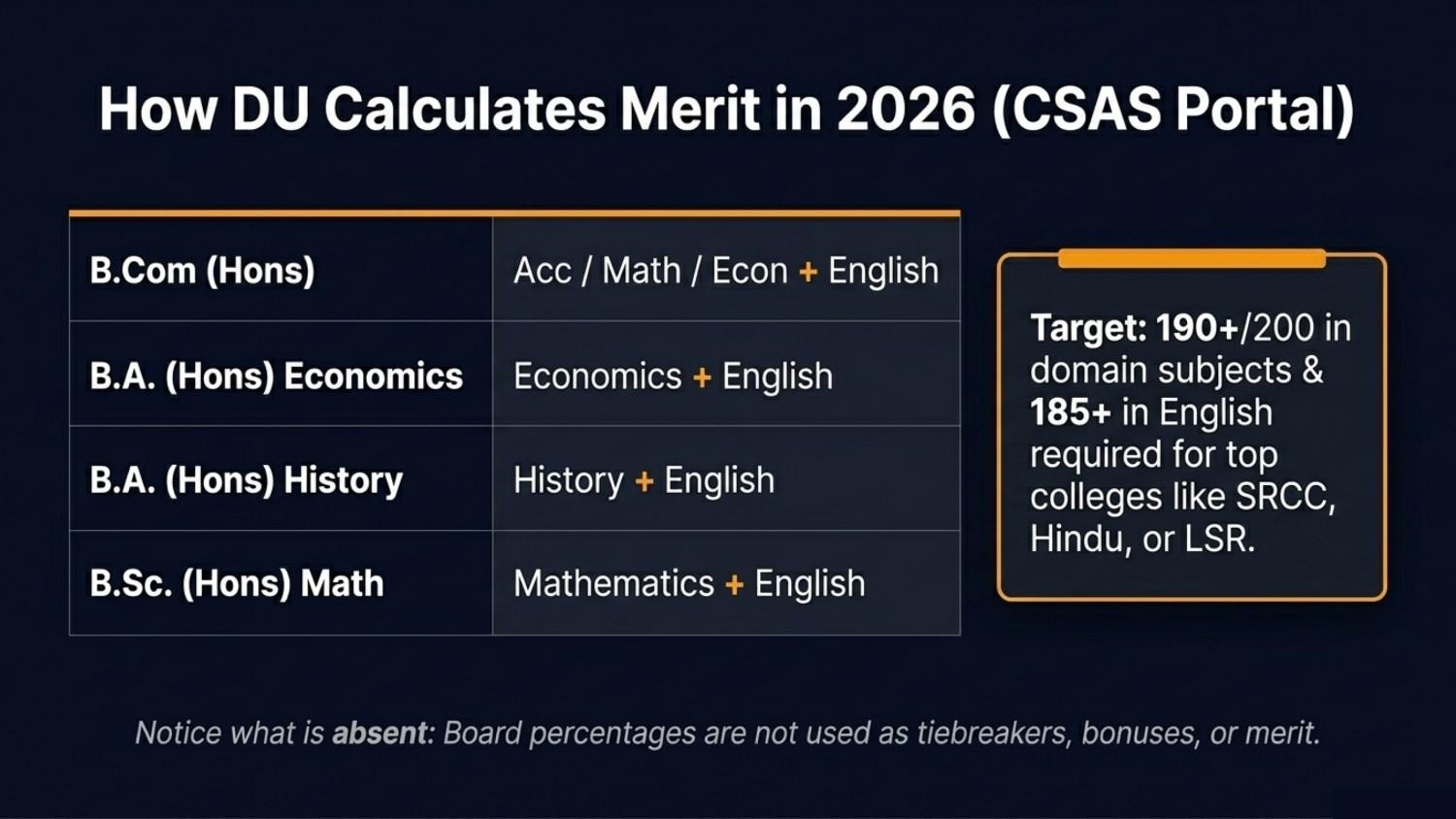
How DU actually calculates your admission score in 2026
DU uses a Common Seat Allocation System (CSAS). After CUET results are declared, students register on the CSAS portal and fill program-college preferences. DU then calculates a program-specific merit score based on CUET performance in the relevant subject combination. Here is how it works for a few popular programs:
| Program | CUET subjects used for merit |
|---|---|
| B.Com (Hons) | Best of: Accountancy / Mathematics / Economics + English |
| B.A. (Hons) Economics | Economics + English (or best language score) |
| B.A. (Hons) History | History + English |
| B.A. (Hons) Psychology | Psychology + English |
| B.Sc. (Hons) Mathematics | Mathematics + English |
Notice what is absent from every row: your board percentage. DU's merit formula does not include it. Not as a tiebreaker, not as a bonus, not in any form. For most top DU programs, you need 190+ out of 200 in your domain subject and 185+ in English to have a realistic shot at SRCC, Hindu College, or LSR. At Hansraj, Kamala Nehru, or Kirori Mal, 170–185 is often sufficient depending on the program and category.
Start CUET prep now on PrepTribe
Where board marks still matter — be honest about these
Boards are not completely irrelevant. Here is where they still count:
Private universities not on CUET: Institutions like BITS Pilani (which uses BITSAT + board marks), Ashoka University, OP Jindal, and Flame University either have their own entrance exams or use board marks as part of their criteria. If these are on your shortlist, boards still matter.
State universities: Not all state universities have adopted CUET. Many still use board percentage-based merit lists — particularly for programs that CUET does not cover. Always check the specific university's admission notification for 2026.
Scholarships: Most merit scholarships — school-level, state government, and some central government scholarships — still use board marks as the primary criterion. A high board score can unlock financial support even if it does not help with central university admission.
Minimum eligibility for programs: Some programs have minimum percentage requirements beyond just passing — typically 45% or 50% in relevant subjects. These are rare but exist, especially at deemed universities. Check the specific program brochure.
Your own college admission in Class 12: The school you attend for Class 11 and 12 has its own cutoffs for streams, which are based on your Class 10 boards. That is the last time boards play a gatekeeping role in the traditional sense.
The student mistake this creates — and how to avoid it
The shift from boards to CUET created a new mistake that is now common among Class 12 students: over-investing in board preparation at the cost of CUET preparation.
A student who scores 96% in boards but only 160/200 in CUET will not get into SRCC. A student who scores 82% in boards and 192/200 in CUET will. This is the new reality, and students who do not adjust their study strategy accordingly pay for it in July when seat allocations are announced.
The practical implication: from January of Class 12, your CUET preparation should be getting at least as much time as your board preparation — arguably more. Boards require you to pass (and pass well for private university options). CUET requires you to beat thousands of students on a single timed test.
Frequently asked questions
My board percentage is low (below 75%). Can I still get into a central university? Yes, as long as you have passed Class 12 with the relevant subjects. For most central universities, there is no minimum board percentage for CUET-based admissions beyond passing. Your CUET score is all that determines your merit rank.
Does JNU use boards at all for UG admissions in 2026? No. JNU shifted to CUET for all UG programs from 2022. Board percentage is used only to verify eligibility (that you have studied the relevant subjects and passed Class 12). The merit list is based entirely on CUET scores and JNU's subject-specific weightage formula.
Will BHU also admit only through CUET in 2026? Yes. BHU uses CUET scores for all central university undergraduate programs. Centralised counselling assigns seats based on CUET score + category.
What if I scored well in boards but did not prepare for CUET? Then you are in the same position as every student who scored 100% in boards in 2021 — except the game changed. Start CUET preparation immediately. CUET 2026 is in May, which means intensive preparation from now is still meaningful. Focus on your domain subjects and English — timed practice is the single most important skill to build.
Can I use last year's CUET score for 2026 admissions? CUET scores are valid for the current year's admissions only. You cannot carry forward a 2025 CUET score to 2026 admissions. If you did not appear in CUET 2026 or want to improve your score, you would need to appear again in 2027.

Final verdict
Board marks got you into the conversation for Class 12. They set the foundation. But for DU, JNU, BHU, Jamia, Allahabad University — and all 45 central universities — board marks ended their role as an admission currency in 2022. CUET is the only score that matters for the merit list.
The students who get this right do not chase board percentages at the cost of CUET preparation. They pass their boards confidently, and they prepare for CUET like the competitive entrance exam it is.