NIT vs private engineering colleges 2026: which is the better choice for JEE aspirants?
NIT vs private engineering colleges 2026: which is the better choice for JEE aspirants?
Quick summary
-
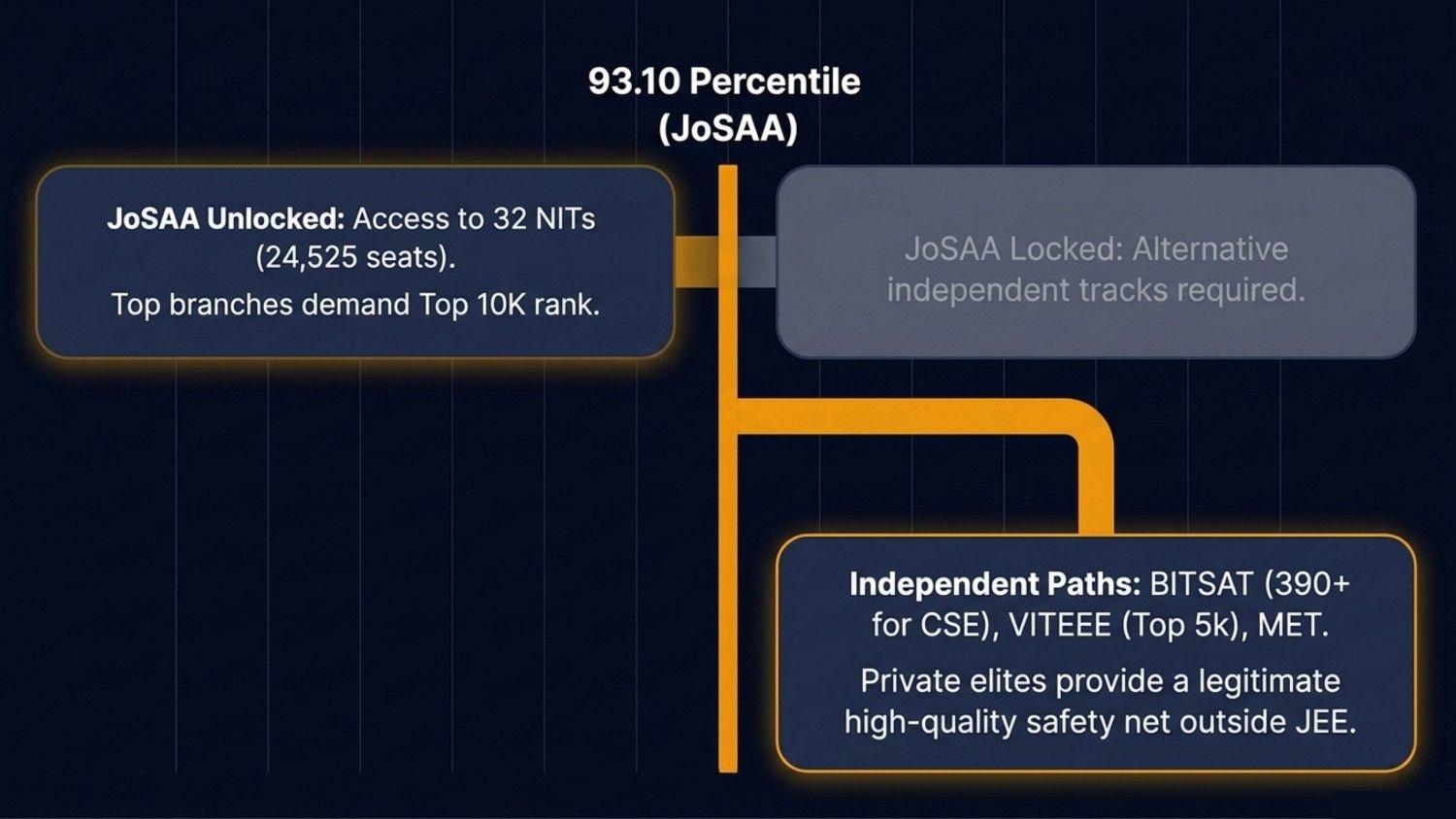
There are 32 NITs in India with 24,525 seats (JoSAA 2025). Getting one requires clearing JEE Main — and typically above the 93.10 percentile mark for top NITs in popular branches.
-
NITs offer subsidised fees (₹1–1.5 lakh/year), strong alumni networks, and government-backed credibility. Their weakness: location limits, branch availability, and hostel infrastructure at newer NITs.
-
Top private colleges — BITS Pilani, VIT, Manipal, Thapar — offer comparable or stronger placements in specific branches, better campus facilities, and more flexibility. Their weakness: higher fees (₹3–6 lakh/year) and significant quality variation across the private sector.
-
The "NIT vs private" question has no universal answer. It depends on your rank, branch preference, city of preference, and what you want from college beyond a degree.
Introduction
Every year, after JEE Main results drop, thousands of students face the same question: should I take a mid-tier NIT, or opt for a top private college that accepts my score? It sounds like a simple comparison. It is not.
The NIT vs private debate is one of the most mishandled decisions in Indian engineering admissions — mostly because students compare a top NIT (say, NIT Trichy) against an average private college, or a top private college (BITS Pilani) against a newer, less-established NIT. That comparison tells you nothing useful.
This post makes an honest, data-backed comparison for 2026 — fees, placements, admission criteria, and what no one tells you about either choice.
📌 Also check on EduNext: A Preptribe by EduNext.
The basics: what NITs and top private colleges actually are
NITs (National Institutes of Technology) are centrally funded technical institutions established by Parliament under the NIT Act 2007. There are 32 NITs across India. Admission is through JoSAA counselling based on JEE Main rank and category. Fees are regulated by the government and are significantly lower than private colleges.
Top private engineering colleges is a broad category. It includes:
- BITS Pilani (and Goa, Hyderabad campuses) — which uses BITSAT, not JEE Main
- VIT Vellore and Chennai — uses VITEEE
- Manipal Institute of Technology — uses MET / direct admission
- Thapar Institute, Patiala — accepts JEE Main score
- SRM Institute of Science and Technology — SRMJEEE
- Amity, LPU, Chandigarh University and hundreds of others
The key distinction: the top 5–8 private colleges are genuinely competitive with NITs. The bottom 200+ private colleges are not. Any comparison that lumps them together is misleading.
Fees: the most visible difference
This is where NITs have a clear structural advantage.
| Institution Type | Annual Tuition | 4-Year Total (Approx.) | SC/ST Fee |
|---|---|---|---|
| Top NIT (Trichy, Warangal, Surathkal) | ₹1.25–1.50 lakh | ₹5–6 lakh | Significantly reduced / waiver |
| New/Tier-2 NIT | ₹1.00–1.25 lakh | ₹4–5 lakh | Significantly reduced / waiver |
| BITS Pilani (Pilani campus) | ₹5.50–6.00 lakh | ₹22–24 lakh | No tuition waiver |
| VIT Vellore (CSE) | ₹3.75–4.00 lakh | ₹15–16 lakh | Limited scholarships |
| Thapar Institute (CSE) | ₹3.50–4.00 lakh | ₹14–16 lakh | Limited scholarships |
| Manipal Institute of Technology | ₹3.50–4.50 lakh | ₹14–18 lakh | No tuition waiver |
Fee data indicative for 2025–26 academic year. Verify with individual college admission brochure before deciding.
For SC/ST/PwD students: NITs offer fee waivers and scholarships that private colleges typically do not match. This alone makes NITs the financially rational choice for students from these categories.
For General/OBC students without financial constraints, the 3–4x fee difference still matters — but needs to be weighed against branch, placement, and career outcome.
📌 Also check on EduNext: Scholarship Finder for Engineering Students — SC/ST/OBC/EWS fee waivers, merit scholarships, and state government grants available at NITs and private colleges.
Placements: where it gets complicated
The honest answer: placement data is the most manipulated metric in Indian higher education. Both NITs and private colleges selectively report their best numbers.
Here is what verified data actually shows:
Top NITs (Trichy, Warangal, Calicut, Surathkal, VNIT Nagpur):
- Average packages: ₹12–18 LPA for CSE/ECE branches (2024–25 placements)
- Highest packages: ₹40–80 LPA (international offers, selective)
- Core engineering recruitment: Strong — PSUs, L&T, Infosys, TCS, Wipro, Bosch, ABB
- Product company/startup hiring: Good at top 5 NITs, mixed at others
BITS Pilani:
- Average packages: ₹18–22 LPA (CSE, 2024–25)
- Strong tech placements with Google, Microsoft, Goldman Sachs, DE Shaw
- Practice School programme gives students real work experience before graduation
- Industry reputation: Consistently among the top 10 in employer perception
VIT Vellore, Manipal, Thapar:
- Average packages vary widely — ₹7–14 LPA across branches
- Placement percentages can be inflated; verify with branch-specific data
- Strong IT/software hiring, weaker for core engineering
The honest comparison: BITS Pilani outperforms most NITs in placement quality and alumni depth. VIT, Manipal, and Thapar are roughly comparable to mid-tier NITs (NIT Jamshedpur, NIT Bhopal, NIT Rourkela) depending on branch. A lower-ranked private college almost never outperforms any NIT.
Admission: who gets in where
| Institution | Entrance Used | 2025 Approx. Cutoff (CSE, General) |
|---|---|---|
| NIT Trichy CSE | JEE Main (JoSAA) | Top 5,000–8,000 rank |
| NIT Warangal CSE | JEE Main (JoSAA) | Top 5,000–9,000 rank |
| NIT Surathkal CSE | JEE Main (JoSAA) | Top 8,000–12,000 rank |
| NIT Calicut CSE | JEE Main (JoSAA) | Top 10,000–14,000 rank |
| New NITs (Silchar, Manipur, Mizoram) | JEE Main (JoSAA) | 60,000–1,50,000 rank |
| BITS Pilani CSE | BITSAT | 390–400/450 score |
| VIT Vellore CSE | VITEEE | Top 5,000 rank in VITEEE |
| Thapar CSE | JEE Main / direct | 40,000–80,000 JEE rank |
The JEE Main qualifying cutoff for NIT/IIIT/GFTI access was 93.10 percentile for General/CRL in 2025. Students below this cutoff cannot access JoSAA at all — which means top NITs are only in the picture if you clear this bar and rank well within it.
What NITs do better
Government-backed credibility: NIT degrees carry institutional weight with PSUs (ONGC, BPCL, BHEL, ISRO, HAL) that routinely prefer NIT graduates for core engineering roles. Private college graduates have less access to PSU recruitment.
Research and higher studies: Top NITs have better GATE coaching culture and connections to IIT-level research programmes. Students targeting M.Tech from IIT or MS abroad benefit from the NIT brand.
Affordable fees with comparable outcomes: For a student ranking between 15,000–50,000 in JEE Main, an NIT seat in Mechanical or Civil at a decent campus is often better value than a private college CSE seat at 4x the fee.
Reservation benefits: SC/ST/OBC students get specific seat quotas and fee support that no private college can match.
What top private colleges do better
CSE and tech branches: BITS Pilani, VIT, and Manipal have invested heavily in tech infrastructure, industry partnerships, and placement cells. For students specifically targeting software and product roles, these campuses often outperform mid-tier NITs.
Campus life and infrastructure: Top private colleges typically have better hostels, sports facilities, and campus ecosystems than many NITs — especially the newer NITs in northeastern states.
Flexibility: Private colleges offer more dual-degree options, lateral movements between departments, and non-engineering minors. NITs are more rigid in their structure.
Admissions as a second option: BITS Pilani, Manipal, and VIT run their own entrance tests on separate timelines. A student who misses JoSAA counselling still has a legitimate path to a quality engineering degree.
📌 Also check on EduNext: Compare any two colleges side by side — fees, placements, NIRF rankings, student reviews. NIT Trichy vs VIT Vellore, BITS Pilani vs NIT Warangal — see the actual data.
The decision framework: how to actually choose
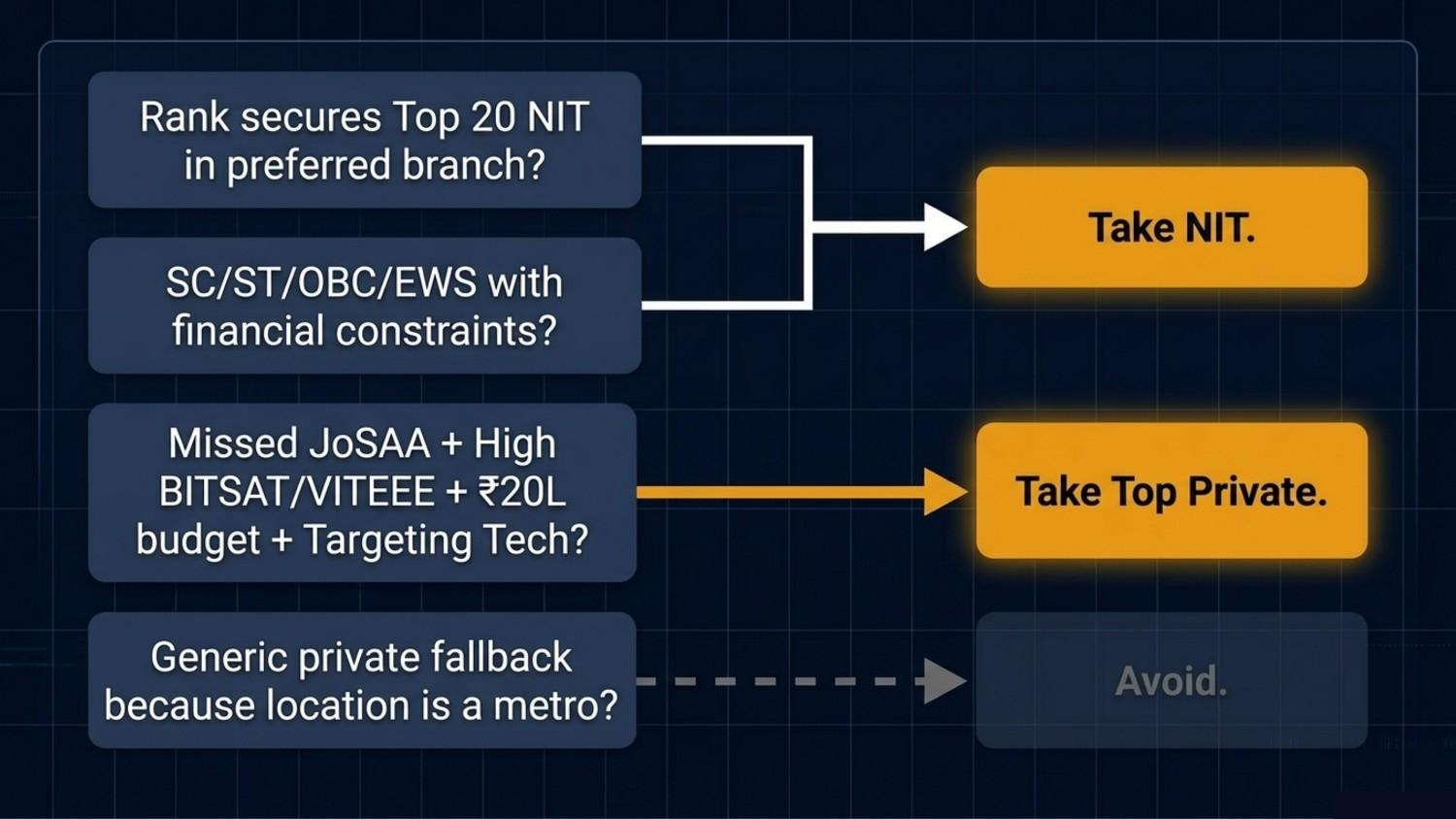
Take the NIT if:
- Your rank secures you a core NIT (top 20 of 32) in a branch you want
- You are from SC/ST/OBC/EWS category — the fee and reservation benefit is significant
- You are targeting PSU jobs or GATE/IIT M.Tech after graduation
- Your family's financial situation makes ₹22 lakh fees impractical
Take the private college if:
- You are comparing BITS Pilani / top private specifically (not generic private)
- Your JEE Main rank only gives you a new NIT in a branch you do not want
- You are specifically targeting software, product, or startup hiring in CSE
- You can independently verify strong placement data for your specific branch at that college
Never take a private college just because:
- It is in a metro city (location alone does not improve placements)
- It claims "100% placement" without branch-specific breakdown
- Your JEE rank was low and you feel any private college is a "safer" fallback
Frequently asked questions
Is an NIT better than VIT for CSE? It depends on the NIT. NIT Trichy, Warangal, or Surathkal CSE is better than VIT CSE by most measures — alumni network, PSU access, and research output. But NIT Silchar or NIT Manipur CSE vs VIT Vellore CSE is a genuinely close call where campus infrastructure and placement records at VIT may tip the balance.
Can I get into a good NIT with 85 percentile in JEE Main? The JEE Main cutoff for NIT/IIIT/GFTI access (JoSAA) was 93.10 percentile for General/CRL in 2025. At 85 percentile, you would not qualify for JoSAA counselling. Private colleges running their own entrance tests (BITSAT, VITEEE, MET) would be your main options.
Do private engineering colleges have PSU placements? Most PSUs — ONGC, BHEL, BPCL, ISRO, HAL — recruit from NITs, IITs, and IIITs primarily. Private college students can appear for GATE and then target PSUs through that route, but campus PSU recruitment is rare at private colleges outside BITS Pilani.
Is BITS Pilani better than the top NITs? BITS Pilani consistently outperforms most NITs in software and product company placements and is comparable to the top 5 NITs (Trichy, Warangal, Surathkal, Calicut, VNIT) in overall reputation. But the fee difference — BITS at ₹22–24 lakh total vs NIT at ₹5–6 lakh total — is significant. Factor in ROI, not just brand.
Which NIT has the best placements in 2025? Based on 2024–25 placement data, NIT Trichy, NIT Warangal, and NIT Surathkal consistently lead in average packages and quality of recruiters. NIT Calicut and VNIT Nagpur follow. Always ask for branch-specific placement data, not college-wide averages.
Final verdict
The NIT vs private college debate is not a question of prestige — it is a question of value, fit, and what you specifically want from four years of engineering.
A seat at NIT Trichy or NIT Warangal in your preferred branch is, in most cases, better than any private alternative at four times the cost. A seat at a new NIT in a branch you do not want is worth comparing seriously against BITS Pilani or VIT Vellore in CSE. And anything below the top 8–10 private colleges is almost never worth choosing over an NIT.
Do not decide based on city, campus aesthetics, or what your peer group is doing. Decide based on branch, verified placement data, and your family's financial picture.