Deemed vs State vs Central University: A Plain-English Guide
Blog
Leave your details and our counselors will reach out to you shortly.
Deemed vs State vs Central University: A Plain-English Guide
Picking a college in India means running into a confusing set of labels: central university, state university, deemed university, and sometimes private university too. Students and parents often assume one label means "better" or "worse." In reality, each type is set up differently, funded differently, and admits students differently.
This guide explains the real differences in simple terms, so you can decide which type fits your goals, budget, and course.
The Short Answer
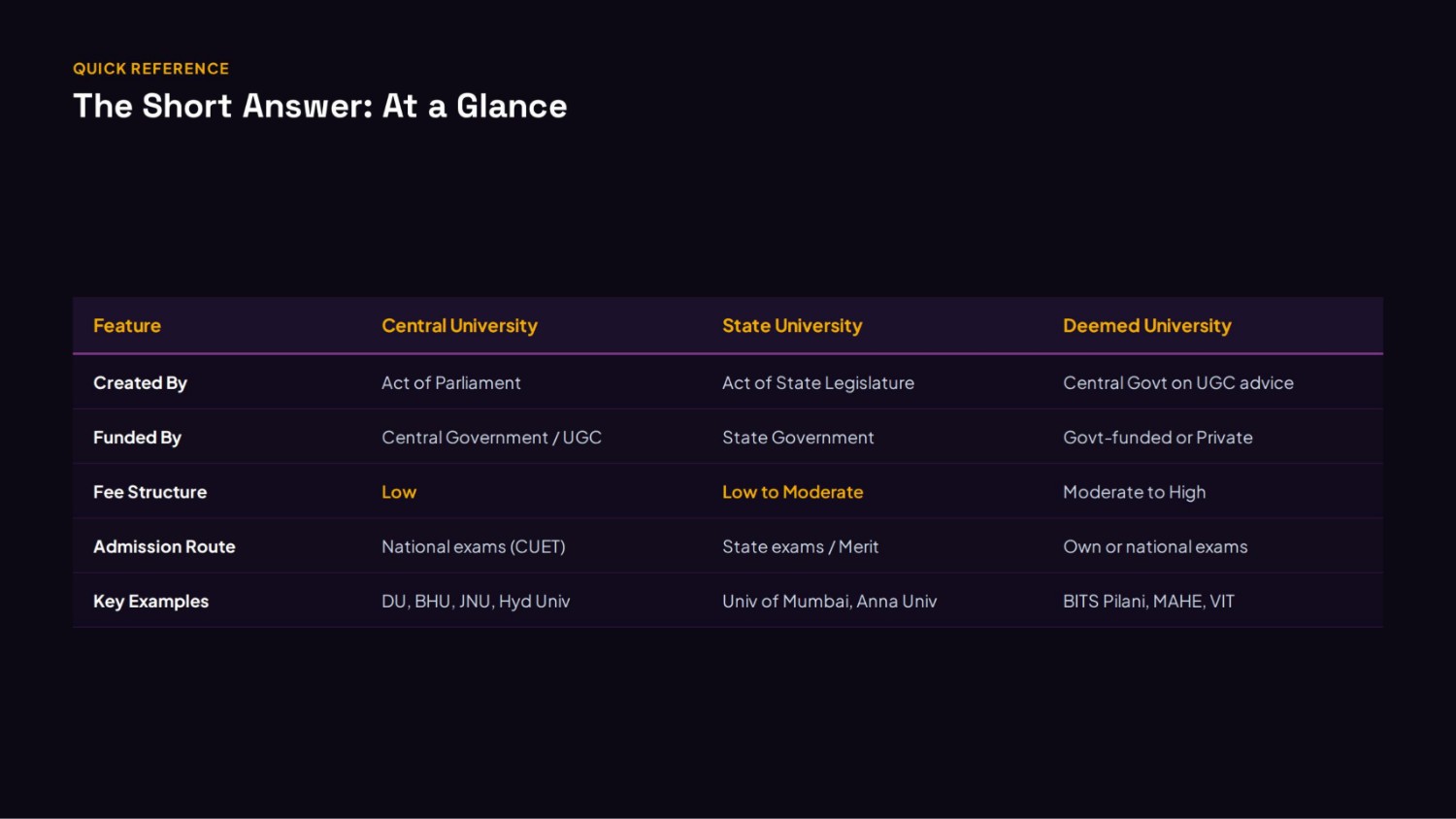
| Central University | State University | Deemed University | |
|---|---|---|---|
| Created by | Act of Parliament | Act of a State Legislature | Declared by the Central Government on UGC's advice |
| Funded by | Central Government | State Government | Government-funded or privately run |
| Typical fees | Low | Low to moderate | Moderate to high |
| Admission route | Mostly national exams (e.g., CUET) | State entrance exams or merit-based counselling | Own entrance exam or national exams |
| Own curriculum and exams? | Yes | Yes (affiliated colleges follow the university's) | Yes, with more freedom to design courses |
| Examples | Delhi University, BHU, JNU, University of Hyderabad | University of Mumbai, Osmania University, Anna University | BITS Pilani, Manipal Academy of Higher Education, VIT, Symbiosis |
Examples are illustrative. Always check a university's current status on official sources before applying.
 **
What Is a Central University?
A central university is established by an Act of Parliament and funded by the Government of India, mainly through the Ministry of Education and the University Grants Commission (UGC).
What this means for you:
- Affordable fees. Government funding keeps tuition low, which is a big reason competition is intense.
- National-level admission. Most undergraduate admissions go through a common national test, so students from across India compete for the same seats.
- Diverse campuses. Because students come from every state, you meet peers from many backgrounds.
- Strong brand value. Several central universities are well known in arts, sciences, humanities, and social sciences.
Things to keep in mind: Seats are limited, cut-offs can be very high, and facilities and placements vary a lot between universities and between departments.
What Is a State University?
A state university is established by a State Legislature Act and funded mainly by the state government. Many state universities also affiliate local colleges, meaning those colleges teach the university's syllabus, and the university conducts exams and awards the degree.
What this means for you:
- Lower fees. State government support keeps costs modest, especially for in-state students.
- Domicile advantage. Many states reserve a share of seats for local students.
- Wide choice of colleges. One state university can have hundreds of affiliated colleges, from excellent to average.
- Strong regional networks. Useful if you plan to work in the same state.
Things to keep in mind: Quality differs widely across affiliated colleges, and syllabus updates and exam schedules can sometimes be slower. Always judge the specific college, not just the university's name.
What Is a Deemed University?
A deemed-to-be university is an institution that the Central Government, on the advice of the UGC, has declared eligible to function like a university. Deemed universities can be government-funded or privately managed.
What this means for you:
- Academic freedom. They can design their own courses, syllabi, and assessment methods, which often means newer, industry-linked programmes.
- Own admission process. Many run their own entrance exams or use national tests, and some conduct their own counselling.
- Higher fees. Most are self-financed, so tuition and other charges are usually higher than at government institutions.
- Variable quality. Some are among India's most respected institutions, while others are far less established.
Things to keep in mind: Compare the fee structure carefully, check the status of the specific course you want, and look at independent data such as NIRF rankings and placement reports instead of relying on the "deemed" tag alone.
And What About Private Universities?
Private universities are a separate category. They are set up by a State Legislature Act and run by private bodies. They can only operate within the state that created them, and they are regulated by the UGC. They are often confused with deemed universities, but legally they are different.
Do Degrees Differ in Value?
A common worry is whether a degree from one type is "less valid." If the university is recognised by the UGC, its degree is valid for higher studies and government and private jobs, subject to the specific eligibility rules of each exam or employer.
What matters far more than the label is:
- The reputation of the specific institution and department
- Accreditation and rankings (NAAC grades, NIRF rank, NBA for professional courses)
- Quality of faculty and curriculum
- Placement and internship record for your course
- Regulatory approval for professional programmes (for example, AICTE, NMC, BCI, or PCI where applicable)
How to Choose: A Simple Decision Guide
Choose a central university if:
- You want low fees and a nationally recognised brand
- You are comfortable with a competitive national entrance exam
- Your course is in arts, science, humanities, or social sciences
Choose a state university if:
- You want an affordable degree close to home
- You qualify for domicile reservation
- You will research the affiliated college carefully before applying
Choose a deemed university if:
- You value updated, industry-linked curricula and flexibility
- You can afford the fees or have a scholarship or education loan plan
- The institution has strong rankings and placement data for your course
Five Checks Before You Apply
- Verify recognition. Confirm the university's status on the UGC website and the course's approval on the relevant regulator's website.
- Check fees in full. Ask for the complete fee breakup: tuition, hostel, exam, and other charges, for all years.
- Study the placement report. Look for median packages, not just the highest one, and the number of students placed.
- Read the rankings. NIRF and NAAC grades give an independent view.
- Talk to current students and alumni. They will tell you what brochures do not.

Frequently Asked Questions
Is a deemed university better than a state university? Not automatically. Some deemed universities are excellent, and some state universities are outstanding. Judge the specific institution and course.
Are central university degrees more valuable? They often carry strong brand recognition, but employers mostly look at skills, the institution's reputation, and your performance.
Can I do a government job with a deemed university degree? Generally yes, as long as the degree is UGC-recognised and meets the eligibility conditions in the job notification. Always check the notification.
Which type has the lowest fees? Central and state universities are usually the most affordable because of government funding.
Final Thoughts
There is no single "best" type of university. Central universities offer affordability and national prestige, state universities offer accessibility and regional strength, and deemed universities offer flexibility and modern programmes at a higher price. The right choice depends on your course, budget, and career plans.
Whatever you choose, verify recognition, compare fees honestly, and look at real outcomes. A well-chosen college will matter far more than the label on its name.
Need help shortlisting colleges that match your marks, budget, and goals? Explore colleges and get personalised guidance on EduNext.